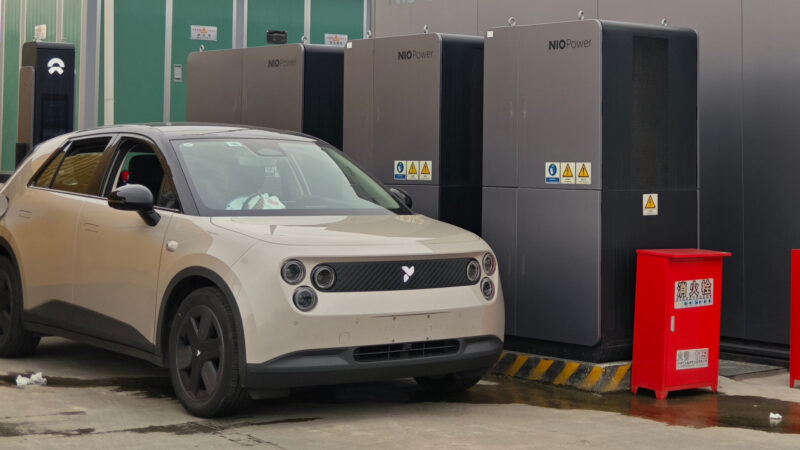

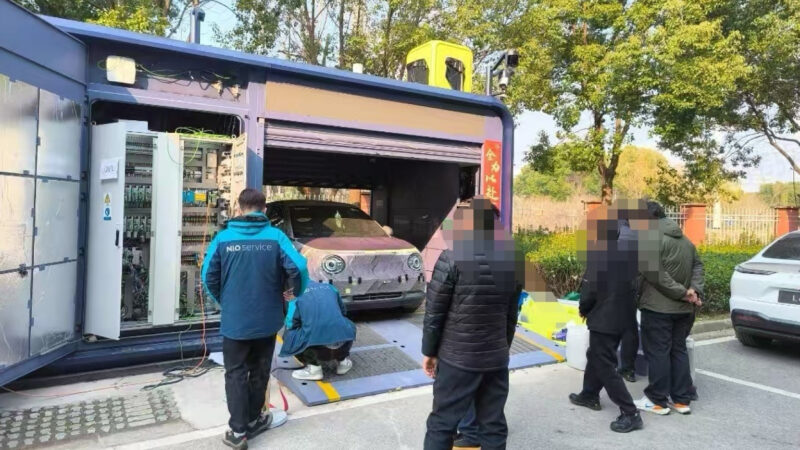
Picture this. It’s just another day in China’s bustling automotive landscape, but something different catches the eye of a sharp-eyed Weibo influencer. There, tucked away in what appears to be a testing area, sits a compact purple structure that looks familiar yet distinctly new. This isn’t just any charging station. It’s Nio’s Firefly battery swap station, making its first public appearance in China, and it’s about to change how urban dwellers think about electric vehicle ownership.
The spy shots that surfaced on April 9 tell a story of careful planning meeting bold execution. You can see Nio service employees going about their business, a white Onvo L60 parked nearby, and most importantly, a test Firefly EV positioned at the station, likely running through its first battery swaps. The purple finish isn’t just for show. It’s part of the new brand’s identity, a splash of color in the often-monochrome world of EV infrastructure.
Quick Specs & Metrics: The Firefly EV at a Glance
| Metric | Value | Unit | Notes |
|---|---|---|---|
| Length × Width × Height | 4003 × 1781 × 1557 | mm | Compact urban footprint |
| Wheelbase | 2,615 | mm | Surprisingly spacious interior for class |
| Battery capacity | 42.1 | kWh | Lithium iron phosphate (LFP) chemistry |
| Range (CLTC) | 420 | km | Chinese test cycle; real-world approx. 350 km |
| Battery chemistry | LFP | — | From Sunwoda; excellent safety and longevity |
| Motor power | 105 | kW | 140 horsepower; rear-wheel drive |
| Peak torque | Not specified | Nm | Typical EV instant torque delivery |
| Charging method | Battery swap | — | 3–5 minute battery exchange |
| Recommended daily range | 250–300 | km | Comfortable urban use with buffer |
| Battery supplier | Sunwoda | — | Chinese battery specialist |
The Station That Could Change Urban EV Life
What makes this Firefly swap station so interesting isn’t just its purple paint job, though that certainly helps it stand out. It’s the thinking behind it. The station looks like a scaled-down version of Nio’s fourth-generation power swap stations, but don’t let the smaller size fool you. This thing is packed with the same camera and LiDAR layout as its bigger siblings, meaning it’s just as smart and capable.
From a consumer perspective, this is huge. Imagine living in a dense urban area where parking is scarce and home charging is a luxury few can afford. The Firefly station, designed specifically for large cities with high user density, offers a solution that’s faster than fast charging and more convenient than hunting for a parking spot with a charger. You pull up, the station does its thing in three to five minutes, and you’re back on the road with a fresh battery. No waiting, no planning your day around charging stops.
The station’s compact design is particularly clever. In cities where real estate comes at a premium, every square meter counts. By making the Firefly station smaller than Nio’s standard units, the company can fit them into tighter spaces, potentially placing them in underground parking garages, shopping center lots, or even street-side locations that wouldn’t accommodate larger infrastructure.
Technical Simplicity Meets Daily Practicality
Let’s talk about what’s under the skin, because that’s where the Firefly system really shines. The 42.1 kWh lithium iron phosphate battery from Sunwoda might not sound massive compared to some of the 100 kWh packs in luxury EVs, but for urban driving, it’s perfectly sized. LFP chemistry brings some serious advantages to the table. It’s inherently safer than other battery types, with much lower risk of thermal runaway. It also lasts longer, typically enduring thousands more charge cycles than NMC batteries.
The 105 kW motor delivering 140 horsepower to the rear wheels gives the Firefly enough pep for city driving. You won’t be winning drag races, but you’ll have no trouble merging onto highways or passing slower traffic. More importantly, the rear-wheel drive layout contributes to better weight distribution and handling characteristics that make the car feel more engaging to drive than your typical front-wheel-drive compact EV.
What really sets the Firefly apart, as our comprehensive Firefly review details, is how all these elements come together to create a vehicle that feels premium despite its accessible positioning. The driving experience is surprisingly refined, with noise insulation that keeps the urban chaos outside and a suspension tuned for comfort over China’s sometimes challenging road surfaces.
The Chinese Market Context: Why This Matters Now
If you’ve been following the Chinese EV scene, you know Nio has been betting big on battery swap technology for years. With 3,249 swap stations already operating across China and about 60 more outside the country, they’ve built the largest battery swap network in the world. But there’s a catch. Most of these stations serve Nio’s premium models, which start at price points beyond what many urban consumers can afford.
Enter Firefly. This isn’t just a new car. It’s Nio’s play for the volume market, and the swap stations are a crucial part of that strategy. By creating a more affordable EV with access to the swap network, Nio can bring battery swap convenience to millions of new customers who previously couldn’t justify the premium price tag.
There were rumors floating around that Firefly might use CATL’s battery swap system, given the cooperation agreement between the world’s largest battery maker and Nio. Those rumors haven’t been officially confirmed, and Firefly CEO Daniel Jin has stated that Nio will build the new brand’s swap stations according to user needs. What we do know is that the Firefly swap technology will eventually be integrated into Nio’s fifth-generation power swap stations, creating a unified system that serves multiple vehicle classes.
This approach makes perfect sense when you consider China’s unique market dynamics. Unlike in Europe or North America, where home charging is more common, many Chinese EV owners live in apartment buildings without dedicated parking or charging access. For them, public charging infrastructure isn’t a convenience. It’s a necessity. And as our coverage of Firefly’s global expansion plans shows, this urban-focused strategy has implications beyond China’s borders.
Safety and Value: The Complete Package
One of the most impressive aspects of the Firefly project is how it doesn’t compromise on safety despite its accessible positioning. As we’ve seen in recent safety demonstrations, small EVs can offer protection levels that rival much larger vehicles when designed with modern engineering principles. The Firefly’s LFP battery chemistry adds another layer of safety, with inherent stability that reduces fire risk.
From an ownership perspective, the battery swap model changes the cost equation dramatically. Instead of worrying about battery degradation over time, Firefly owners essentially lease their batteries through the swap system. When battery technology improves, they benefit automatically through station upgrades. There’s no need to sell your car to get the latest battery tech. You just swap into it.
The daily usability story here is compelling. With 420 km of CLTC-rated range (figure on about 350 km in real-world mixed driving), the Firefly covers most urban commutes with days to spare. The swap system means you never need to plan long charging stops. If you’re running low, you find a station, swap, and continue your day. It’s as close to the gasoline station experience as EVs have gotten, but cleaner and often faster.
Looking Ahead: Integration and Expansion
The spy shots we’re seeing represent just the beginning. According to insider information, these Firefly swap stations will initially roll out in large Chinese cities where user density justifies the investment. But the long-term vision is more ambitious. The Firefly swap technology will be integrated into Nio’s fifth-generation power swap stations, creating infrastructure that can serve everything from compact city cars to premium SUVs.
This integration is smart business. Instead of maintaining separate networks for different vehicle classes, Nio can optimize its infrastructure investment while offering customers more options. Need a quick battery swap for your Firefly on your daily commute? Use the compact urban station. Taking your family on a road trip in a larger Nio model? The same fifth-generation station can handle that too.
The implications for China’s EV market are significant. As more affordable EVs like the Firefly gain access to convenient charging solutions, the barriers to EV adoption drop further. It’s not just about making EVs cheaper to buy. It’s about making them easier to live with, especially in challenging urban environments.
The Big Picture: Why This Purple Station Matters
Standing back from the specifics, what we’re really looking at here is the next evolution of EV infrastructure. The Firefly swap station isn’t just another charging point. It’s a thoughtfully designed solution to some of the most persistent problems facing urban EV adoption: space constraints, charging time, and accessibility.
The purple color might seem like a minor detail, but it speaks to something important. This isn’t infrastructure that hides in the background. It’s designed to be noticed, to become part of the urban landscape, and to signal that EV ownership can be convenient, reliable, and even a little bit fun.
As Nio continues to expand its swap network both in China and internationally, the lessons learned from the Firefly system will influence how EV infrastructure develops globally. The compact design, the focus on urban density, the integration across vehicle classes. These aren’t just features. They’re solutions to real problems faced by real people trying to make the switch to electric transportation.
So the next time you see a purple structure in a Chinese city, take a closer look. It might just be a glimpse into the future of how we’ll all power our electric vehicles, one quick swap at a time.