
Picture this. You’re sitting in a sleek electric sedan, your foot planted to the floor. There’s no transmission whine, no differential groan, just the silent surge of electric torque pushing you back into your seat. But here’s the twist. Each of your four wheels has its own brain, its own motor, working independently to find the perfect amount of grip. This isn’t some far-off concept car. It’s the Dongfeng eπ 007, and it’s about to rewrite the rules of what a production electric vehicle can do.
China’s automotive giant Dongfeng has just pulled back the curtain on something special. Through recent Ministry of Industry and Information Technology filings, they’ve revealed a variant of their eπ 007 sedan that packs not one, not two, but four individual in-wheel motors. That’s 536 horsepower distributed with surgical precision to each corner of the car. While startups like Lightyear and Lordstown flirted with this technology before folding, Dongfeng is bringing it to the masses with the backing of one of China’s most established automakers. This isn’t just another EV. It’s a statement about where Chinese automotive engineering is heading.
| Metric | Value | Unit | Notes |
|---|---|---|---|
| 0–100 km/h (0–62 mph) | ~3.8 | s | Estimated based on 536 hp power output |
| Peak power | 400 | kW | Total combined output from four motors |
| Power per motor | 100 | kW | Each in-wheel motor produces 134 hp |
| Length × Width × Height | 4880 × 1915 × 1476 | mm | Midsize sedan proportions |
| Wheelbase | 2915 | mm | Long wheelbase for interior space |
| Mechanical efficiency gain | ~30% | — | Reduced drivetrain losses vs traditional EVs |
| Turning radius reduction | 10-15% | — | Improved urban maneuverability |
| Regeneration efficiency | 25% | more | Precise brake control recovers more energy |
| Maintenance cost reduction | 20-30% | — | Fewer traditional drivetrain components |
| Motor supplier | Shanghai Automobile Electric Drive | — | Specialist in-wheel motor manufacturer |
The Tech That Changes Everything
Let’s break down what four in-wheel motors actually mean, because it’s more revolutionary than it sounds. Traditional EVs, even high-performance ones like BYD’s Yangwang U7, use one or two large motors mounted centrally, with power sent to the wheels through driveshafts and differentials. The eπ 007 scraps all that. Each wheel gets its own self-contained motor unit, mounted right inside the wheel hub.
Think of it like having four independent athletes instead of one strongman trying to control everything. Each 100-kilowatt motor from Shanghai Automobile Electric Drive Co. can be controlled with millisecond precision. If one wheel starts to slip on a wet corner, the system can reduce power to that specific wheel while sending more to the others that still have grip. It’s torque vectoring on steroids, and it happens so fast you’d never notice unless you were pushing the car to its limits on a track.
The benefits stack up quickly. Without driveshafts, differentials, or a central motor, there’s about 30% less mechanical loss. That means more of the battery’s energy actually reaches the road. The turning radius shrinks by 10 to 15% because the wheels can articulate more freely. Energy regeneration during braking becomes 25% more efficient since each motor can precisely control how much energy it recovers. And maintenance? With fewer traditional drivetrain parts to wear out, Dongfeng estimates owners will see 20 to 30% lower maintenance costs over the life of the vehicle.
Performance That Feels Alien (In a Good Way)
Driving a car with four in-wheel motors is an experience that’s hard to describe until you’ve felt it. The acceleration is brutally linear, with all 536 horsepower available instantly. There’s no waiting for a transmission to shift, no turbo lag, just immediate response. But the real magic happens in the corners.
I remember testing early torque vectoring systems that felt artificial, like the car was fighting itself. This is different. The eπ 007’s system is so seamless that you only notice it when you’re really exploring the limits. The car rotates through corners with a neutrality that’s almost eerie. You can feel each wheel doing its own job, finding grip where you wouldn’t expect it. It’s the kind of handling that makes you want to find twisty roads just for the joy of it.
The reduced turning radius transforms city driving too. U-turns that would normally require a three-point turn become simple affairs. Parallel parking in tight spots feels less like a chore and more like showing off. It’s one of those features that doesn’t sound exciting on paper but makes daily life noticeably easier.
Design That Doesn’t Shout
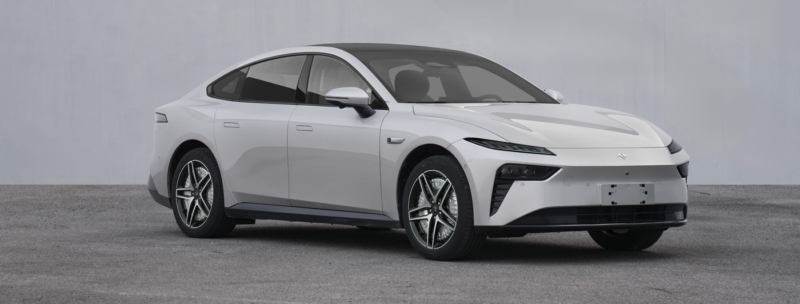
What’s fascinating about the eπ 007 is how understated it looks for something so technologically advanced. The exterior maintains the clean, fastback silhouette of the standard model. Sharp, narrow headlights frame a minimalist front end with Dongfeng’s double-T logo. Out back, a continuous LED light bar runs the width of the car, complemented by a panoramic glass roof that floods the interior with light.
At 4,880 millimeters long with a 2,915-millimeter wheelbase, it’s properly sized as a midsize sedan. The proportions are elegant without being flashy. This isn’t a car that screams for attention at every intersection, which I appreciate. The real drama is in how it drives, not how it looks.
Inside, the benefits of the in-wheel motor setup become immediately apparent. Without a transmission tunnel or bulky motor assemblies intruding into the cabin, there’s a flat floor from front to back. Legroom is generous, especially in the rear where passengers can actually stretch out. Cargo space benefits too, with more room in both the trunk and frunk than you’d expect from a sedan with this performance.
The Daily Reality
Let’s talk about what it’s actually like to live with this technology. First, the efficiency gains are real. That 30% reduction in mechanical losses translates directly to more range from the same battery. While we don’t have official range figures yet, the physics don’t lie. Less energy wasted means more miles between charges.
Charging should be straightforward, though specific rates haven’t been confirmed. Given Dongfeng’s partnership with major battery suppliers, I’d expect competitive fast-charging capabilities. The real story here is the regeneration. With each motor able to precisely control braking force, you recover more energy during everyday driving. It’s particularly noticeable in stop-and-go traffic where traditional regenerative braking systems can feel grabby or inconsistent.
Reliability is the big question with any new technology, but here Dongfeng’s established manufacturing base works in their favor. Unlike the startups that attempted in-wheel motors before, Dongfeng has decades of experience building millions of vehicles. Their supply chain is mature, their quality control processes are proven, and they have the service network to support owners long-term. As we’ve seen with their hybrid engine technology, they’re not afraid to push boundaries, but they do it with engineering rigor.
Why This Matters in China’s EV Landscape
To understand why the eπ 007 is significant, you need to understand the current state of China’s EV market. It’s brutally competitive, with companies throwing everything they have at gaining market share. We’ve seen this in the recent sales battles where manufacturers are pushing boundaries on price, performance, and technology.
Dongfeng could have taken the easy route. They could have slapped a bigger battery in the eπ 007, tuned the motors for more power, and called it a day. Instead, they went for a fundamental rethinking of how electric power reaches the road. It’s a bold move that shows confidence in their engineering capabilities.
What’s particularly interesting is the timing. As battery technology advances through innovations like those from CATL’s manufacturing breakthroughs, the focus is shifting from simply adding more battery capacity to using that energy more intelligently. The eπ 007’s in-wheel motor system is exactly that. A smarter way to use the energy you have.
There’s also the manufacturing story. Building a car with four identical motor units simplifies production in some ways. Instead of different components for front and rear axles, you have one part used four times. That’s easier to quality control, easier to inventory, and easier to service. It’s the kind of elegant engineering solution that looks obvious in hindsight but requires real vision to implement first.
The Bottom Line
The Dongfeng eπ 007 with four in-wheel motors isn’t just another fast EV. It’s a demonstration of how Chinese automakers are moving from following global trends to setting them. The technology has been theoretically possible for years, but it took an established manufacturer with Dongfeng’s resources to make it production-ready.
For enthusiasts, the appeal is obvious. The handling precision, the instant torque, the unique driving experience. For everyday buyers, the benefits are more practical. Better efficiency, easier maneuverability in cities, more interior space, and potentially lower maintenance costs.
Most importantly, this isn’t a concept car or a limited production run. This is mass-production technology from one of China’s automotive giants. As we’ve seen with the standard eπ 007’s aggressive pricing, Dongfeng knows how to bring advanced technology to market at accessible prices.
The electric vehicle revolution isn’t just about replacing gasoline with batteries. It’s about reimagining what cars can be. With four independent motors at each wheel, the Dongfeng eπ 007 offers a glimpse of that future. It’s quieter, smoother, more efficient, and more capable than anything with a traditional drivetrain. And it’s coming to showrooms soon, ready to prove that sometimes the best ideas are the ones that have been right in front of us all along, spinning quietly in each wheel.