
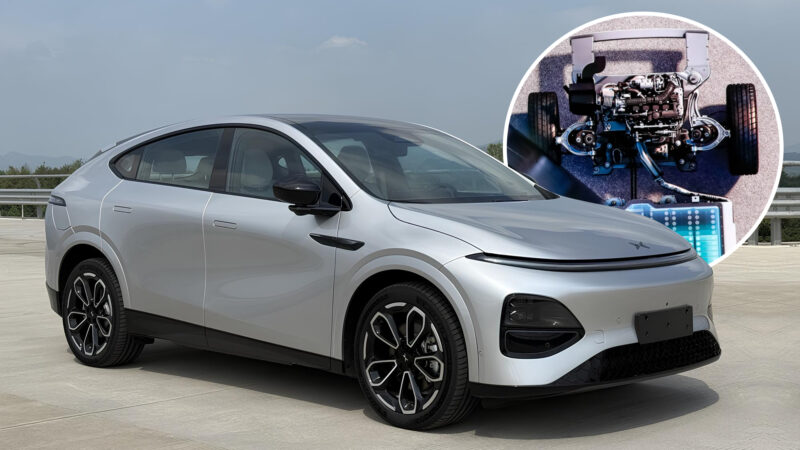
The Xpeng G6 EREV fastback SUV has officially revealed its core specifications in China, marking Xpeng’s stronger push into the competitive hybrid market. This new range-extended variant packs a single electric motor on the rear axle, paired with an internal combustion engine made by Changan.
Unpacking the Electrified G6
The all-electric G6 hit the roads in June 2023, and it has already made its mark. Now, Xpeng is doubling down on its EREV strategy. The company’s Kunpeng EREV powertrain system, initially announced last year, promised a significant 430 km of range and impressive 5C charging tech. We first saw an Xpeng EREV in the form of the X9 minivan hybrid variant, then came the G7 EREV, and now, the G6 fastback SUV joins the ranks.
From the outside, the G6 EREV looks just like its all-electric sibling. It keeps that sleek, sloped front end with headlights neatly tucked into the bumper, a distinctive LED running light strip, those cool retractable door handles, and a smooth roofline that screams modern fastback. Dimensionally, it measures 4771/1920/1650 mm, with a wheelbase of 2,890 mm. You’ll find it rolling on either R18 or R20 wheel options.
Performance and Powertrain Deep Dive
Under the hood, or rather, underneath the rear, the Xpeng G6 EREV flexes with a single e-motor delivering a robust 218 kW (292 hp). Its rated power stands at a steady 110 kW (148 hp), good enough for a top speed of 202 km/h. What truly makes this an EREV, though, is the 1.5-liter turbocharged engine, kicking in 110 kW, which comes from Dongan Powertrain, a subsidiary of Changan. This setup perfectly balances electric drive with the peace of mind of a gasoline extender.
Now, about the battery. The G6 EREV uses an EVE-made LFP pack, but its specific capacity is still under wraps. However, knowing Xpeng’s moves, it will likely feature a 55.8 kWh battery, much like the G7 EREV. This gives us a solid clue about its potential range and efficiency.
Charging Smarts and Real-World Usability
Xpeng has consistently pushed the envelope with charging technology, and its EREV models are no exception. They are set to feature a 5C charging system, meaning you can juiced from 10 to 80% in a mere ten minutes. Even when the mercury drops to a chilling -30°C, a full charge will only take about 15 minutes and 20 seconds. Peak range for these EREV models is quoted at an impressive 450 km. Beyond speed, Xpeng prioritizes durability: these batteries can resist surface temperatures up to 1,000°C, withstand 80 tons of side pressure, and absorb 2,000-joule impacts from underneath. Talk about robust design!
| Metric | Value | Unit | Notes |
|---|---|---|---|
| Peak power (e-motor) | 218 (292) | kW (hp) | Rear axle electric motor |
| Rated power (e-motor) | 110 (148) | kW (hp) | Continuous output |
| Top speed | 202 | km/h | |
| Engine size | 1.5 | Liter | Turbocharged ICE (DAM15NTE from Dongan Powertrain) |
| Engine power | 110 | kW | |
| Dimensions (L/W/H) | 4771/1920/1650 | mm | |
| Wheelbase | 2890 | mm | |
| Battery type | LFP | — | EVE-made, estimated 55.8 kWh capacity |
| Charging speed (10-80%) | 10 | minutes | 5C charging system |
| Low temp charge time (-30°C) | 15 minutes 20 seconds | — | |
| Peak EREV range | 450 | km | |
| Starting Price Estimate | 176,800-198,800 (24,830-27,920) | yuan (USD) | Cheaper than BEV counterpart |
The Consumer Angle and Market Impact
The most exciting news for buyers is the expected price point: the Xpeng G6 EREV will likely be more affordable than its battery electric vehicle (BEV) sibling. We’re talking an estimated 176,800 to 198,800 yuan (approximately 24,830 to 27,920 USD). This aggressive pricing strategy is a smart move, as it will significantly boost the G6 EREV’s appeal in China’s fiercely competitive EV market.
Chinese EV makers are constantly innovating, not just in technology but also in delivering value. Xpeng’s decision to offer a compelling EREV alternative at a lower price point demonstrates a keen understanding of consumer needs. With its stylish design, robust powertrain, advanced charging capabilities, and competitive pricing, the Xpeng G6 EREV looks like a serious contender. It shows that in China, the lines between traditional and electric powertrains are blurring, giving drivers more choices than ever when it comes to performance, efficiency, and daily usability. As more brands jump into the EREV game, we can expect even more exciting options to emerge from this dynamic market. This aligns with broader trends we see in China, where innovation and affordability are key. For instance, brands like BYD and Volkswagen are also actively working on their EV strategies, often looking to partnerships and localized R&D to gain an edge. This continued evolution ensures that whether drivers prioritize raw electric power or the flexibility of a range-extended hybrid, there is a compelling option available.