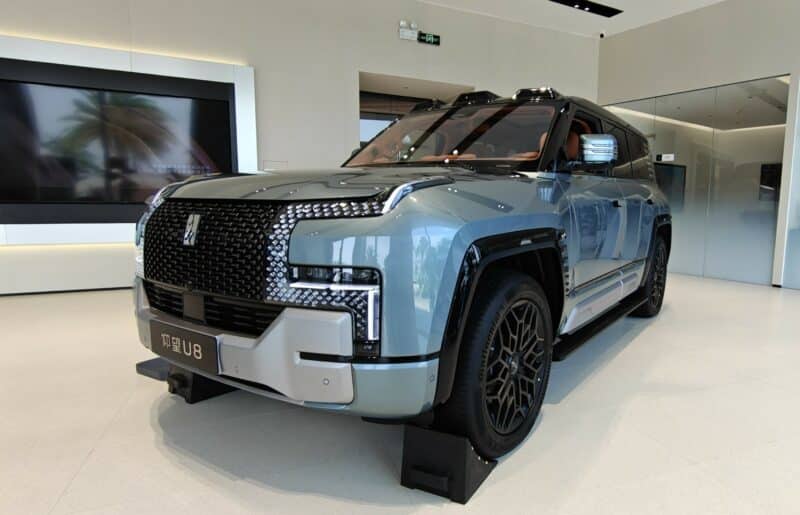


Chinese automotive giant BYD announced its advanced driver-assistance system, tellingly dubbed “God’s Eye,” has now rolled out to over 2 million vehicles across China. This marks a significant milestone reflecting BYD’s aggressive push to integrate sophisticated tech into its diverse lineup. In October alone, sales of vehicles equipped with this assisted-driving capability hit an impressive 316,759 units, showcasing widespread adoption.
Breaking Down October’s ADAS Sales
Looking at the numbers, BYD’s core brand led the charge with 279,724 assisted-driving-equipped cars sold. Its sub-brands also contributed substantially: Fangchengbao moved 29,974 units, Denza added 6,409 units, and the ultra-premium Yangwang delivered 652 units. These figures highlight the broad reach of “God’s Eye” across different market segments, from mainstream to high-end luxury.
Data-Driven Advancement
The “God’s Eye” system isn’t just about features; it’s a massive data-gathering operation. BYD reports that its fleet of sensor-laden vehicles generates over 130 million kilometers of driving-assistance data daily. This enormous volume of real-world data is crucial. It fuels continuous software updates and feature enhancements, ensuring the system evolves and improves over time. The rapid jump from 1.7 million installations earlier in the year to over 2 million now clearly signals growing consumer confidence and adoption.
A Strategic Shift in ADAS Deployment
These October sales figures represent a substantial portion of BYD’s total output, with over 316,000 assisted-driving-equipped units contributing to overall passenger vehicle sales exceeding 430,000. This means the majority of BYD cars sold that month came with ADAS capabilities. While rivals like Nio, Li Auto, and Xpeng often debut such advanced systems on their more expensive models first, BYD has taken a different route. Its strategy involves making ADAS features standard across various pricing tiers, a move that democratizes access to cutting-edge technology and gives BYD a distinct edge in the market. Check out how Xpeng, Leapmotor, and Xiaomi Auto are faring in China’s EV sales race.
Hardware Upgrades Pave the Way
Industry experts in China point out that this accelerated expansion of “God’s Eye” isn’t just good marketing. It’s deeply tied to BYD’s updated hardware platforms like its e-Platform 3.0 and DM-i product lines. Many new models now boast higher-resolution cameras, beefed-up millimeter-wave radar modules, and more powerful computing capabilities. These upgrades allow BYD to seamlessly integrate and standardize assisted-driving features across a wider range of vehicles.
Furthermore, Chinese reports suggest BYD has significantly increased real-world testing. By logging countless kilometers across urban, highway, and suburban environments, the company is refining its system to handle a broader array of traffic behaviors and environmental conditions, ensuring that software updates continually enhance the driving experience. This comprehensive testing approach underpins the reliability and effectiveness of the “God’s Eye” system, cementing BYD’s position as a leader in automotive innovation. As BYD sets its sights on new horizons, its luxury brand, Yangwang, is also preparing to enter Europe in 2026, signaling ambitious global expansion plans. Also, recently, BYD has been significantly boosting its production capabilities, with a fresh emphasis on local manufacturing, as seen with their 70,000th vehicle production milestone in Thailand, which aims to improve exports to European markets.