
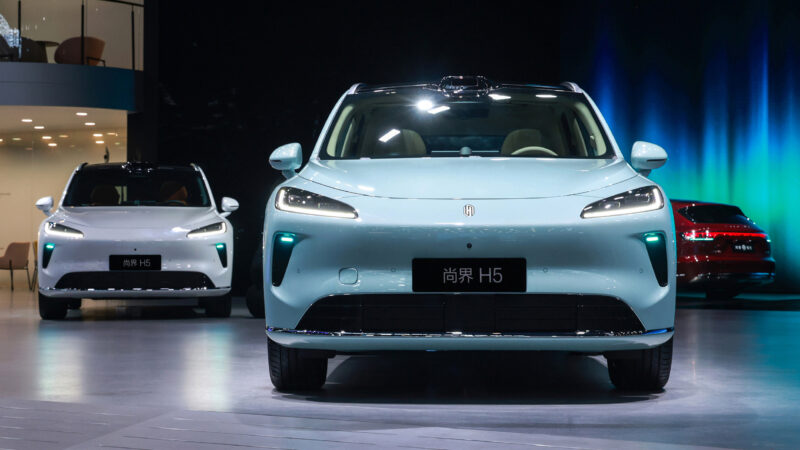
The Saic H5 new energy crossover is making waves in China racking up an impressive 80,000 orders in just 14 days since pre-sales began. This SUV is a product of a collaboration between Shanghai Automotive Industry Corporation and tech giant Huawei. With a starting price of 169,800 yuan, roughly 23,800 USD, the H5 presents a compelling package in the competitive Chinese EV market.
A New Player in Huawei’s HIMA Ecosystem
The Saic H5 introduces a new brand, domestically known as Shangjie, into Huawei’s Harmony Intelligent Mobility Alliance (HIMA) ecosystem. This alliance already includes well-known brands like Aito, Luxeed, Stelato, and Maextro, all leveraging Huawei’s advanced intelligent mobility solutions. While initially referred to as “Shangjie,” the brand’s international identity is now revealed as SAIC, a name that could easily be confused with its manufacturing partner, Shanghai Automotive Industry Corporation (SAIC). To keep things clear, we’ll refer to the HIMA-affiliated brand with a lowercase “saic” and the manufacturing powerhouse with uppercase “SAIC.”
Order Books Overflowing
Saic officials excitedly announced on September 8 that the H5 had secured 80,000 orders in China just two weeks after reservations opened on August 25. That’s a fast pace, with a remarkable 50,000 of those orders pouring in within the first 18 hours alone. These aren’t just idle bookings either, Saic implemented a clever strategy where cumulative orders translate directly into cash discounts for early adopters. Hitting the 50,000 order mark already unlocks a 1,000 yuan, or 140 USD, price reduction. Should orders hit 100,000, that discount doubles to 2,000 yuan (280 USD), and a staggering 150,000 orders would mean a sweet 3,000 yuan (420 USD) off the final price. Deliveries for this hotly anticipated SUV are set to kick off on September 23.
Under the Hood: Power and Practicality
The Saic H5 is a mid-size SUV, measuring in at 4780/1910/1664 mm with a 2,840 mm wheelbase, making it a spacious ride. Its design leans towards a clean, functional aesthetic, featuring classic door handles, an active air intake, and a rooftop LiDAR unit, hinting at advanced driver-assistance capabilities. Inside, you’ll find a comfortable five-seater cabin dominated by a large, floating touchscreen on the center console, while the gear shifter is neatly tucked behind the D-shaped steering wheel.
Underneath its practical exterior, the Saic H5 offers two compelling powertrain options: pure electric vehicle (BEV) and extended-range electric vehicle (EREV). For those leaning into pure electric power, the BEV variant comes with battery options of 64.6 kWh and 80 kWh, delivering a respectable CLTC range of 535 km to 655 km. The electric motor churns out between 150 kW and 180 kW, or 201 to 241 horsepower, depending on the trim, and boasts an impressive energy consumption rate of just 13.4 kWh per 100 km.
If you’re after a bit more versatility, the EREV variant pairs the same 150 kW electric motor with a 1.5-liter naturally aspirated internal combustion engine. This engine acts as a generator, kicking in to extend the range. With a depleted battery, it achieves a fuel consumption of 5.19 liters per 100 km, and its CLTC mixed range stretches to a remarkable 1,300 km. It also packs a 32.6 kWh LFP battery, allowing for an all-electric range of 230 km on the CLTC cycle.
Pricing for Every Preference
The Saic H5 offers a range of trim levels, catering to different needs and budgets, all starting at a competitive price point:
- Saic H5 EREV Pro: 169,800 yuan (23,800 USD)
- Saic H5 EREV Max: 189,800 yuan (26,600 USD)
- Saic H5 BEV Pro: 175,800 yuan (24,650 USD)
- Saic H5 BEV Pro LR: 189,800 yuan (26,600 USD)
- Saic H5 BEV Max: 195,800 yuan (27,450 USD)
- Saic H5 BEV Max LR: 209,800 yuan (29,410 USD)
With strong initial orders and a versatile lineup, the Huawei-backed Saic H5 is positioning itself as a serious contender in China’s booming new energy vehicle market. Its blend of Huawei’s tech expertise and SAIC’s manufacturing prowess seems to be hitting all the right notes with Chinese consumers. This launch further solidifies Huawei’s growing influence in the automotive sector, proving that collaboration is key to success in the EV race. As Chinese EV makers continue to innovate, we’re seeing incredible progress in areas like battery technology and smart features. For instance, brands like Nio are even exploring battery swap stations to enhance convenience and adoption. Meanwhile, other players like Xiaomi are pushing boundaries with new safety patents. It is clear that the Chinese new energy vehicle market is dynamic and full of innovation.