
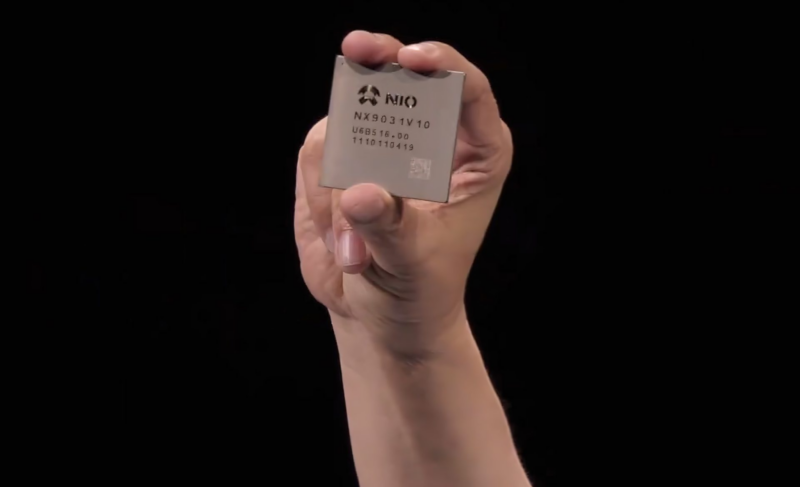
Nio is looking to monetize a major investment by offering its self-developed advanced intelligent driving (AD) chip, the “Shenji NX9031,” for external technical licensing. This move could turn significant research and development costs into a steady income stream for the Chinese EV maker.
Reports from within the chip industry suggest these licensing deals range from several million USD for a single IP authorization to hundreds of millions for a system-level SoC technical authorization.
Unpacking the Shenji NX9031
The Shenji NX9031 chip utilizes a cutting-edge 5nm automotive-grade process, giving it approximately four times the computing power of Nvidia’s Orin-X. This ambitious project, which kicked off in 2021, involved a dedicated team of over 600 professionals covering every aspect of chip development, from front-end design to testing. Its scale and investment far exceeded comparable projects from rivals like Xpeng and Li Auto. In fact, Nio’s CEO William Li once stated that the R&D cost for the NX9031 was equivalent to building 1,000 battery swap stations, translating to an investment upwards of 140 million USD.
Nio’s chip division head, Zhang Danyu, proudly announced in May that the Shenji NX9031 underwent three years of rigorous R&D and testing. The chip not only surpasses some industry-standard benchmarks, but also reached mass production several months before Nvidia’s latest intelligent driving chip, Thor-U. You’ll find it integrated into current Nio models like the ET9, the 2025 ES6, and the EC6. Li also claims it shaves off about 1,400 USD in costs per vehicle, a smart move for Nio as it buckles down to achieve profitability.
Strategic Shift Towards Profitability
Facing considerable cash flow pressure, Nio has been aggressively cutting expenses and seeking new revenue avenues this year. The commercialization of its chip business is a crucial part of this strategy.
Back in June, Nio created Anhui Shenji Technology Co. and tasked it with chip research, development, production, and licensing, all while maintaining strict control. At the time, there were whispers that Nio was hunting for strategic investors for this new entity.
Fast forward to November 14, and Nio’s chip subsidiary took another significant step. Anhui Shenji Technology Co., a Nio offshoot, co-founded Chongqing Chuangyuan Zhihang Technology Co. with Aixin Yuanzhi Semiconductor (Chongqing) Co. and OmniVision Integrated Circuits (Group) Co. This joint venture, with a registered capital of 14 million USD, sees Aixin Yuanzhi Semiconductor holding the largest stake at 36.4%.
The Vision Behind Shenji NX9031
William Li, Nio’s Founder and Chairman, detailed the chip’s progress on his personal Weibo on July 1. He confirmed that the Nio World Model (NWM) had been rolled out to several models including the ET9, new ES6, new EC6, new ET5, and new ET5T, signifying the Shenji NX9031’s successful performance.
Li emphasizes that a truly advanced intelligent driving chip needs three key things: enough computing power and bandwidth to handle about 10 years of future intelligent assisted driving software upgrades, rock-solid safe and reliable operation in tough conditions with ultra-low latency, and excellent all-weather image processing. These were the core ideas that ignited the Shenji NX9031 project back in 2021, and it seems Nio is now ready to let its innovation drive its bottom line and become a major player in the Chinese EV market.