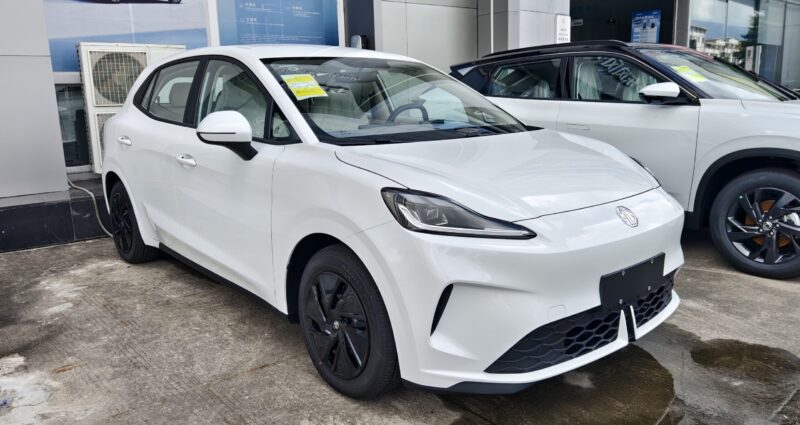

Electric vehicle enthusiasts, get ready: SAIC Motor is making big moves in the battery world. The automaker just announced its partner, Qingtao Power, has fully commissioned its all-solid-state battery production line in Anting. This means we can expect sample cells to roll out by the end of this year, prototype vehicles to hit testing phases next year, and commercial mass-delivery kicking off in 2027. This really sets the stage for a new era of EV performance.
Pushing the Boundaries of Battery Tech
SAIC isn’t shy about its ambitions. They’re targeting some impressive figures for their new solid-state chemistry: a gravimetric energy density exceeding 400 Wh/kg, a volumetric energy density above 820 Wh/L, and individual cell capacities greater than 75 Ah. For those not deep into battery science, these numbers translate to lighter, more compact batteries that can hold significantly more charge. This could mean longer ranges and quicker charging times for future SAIC EVs.
Safety is also a top priority. SAIC reports that these new cells have passed rigorous nail-penetration tests and withstood prolonged exposure in a 200°C thermal chamber without any signs of fire or explosion. Plus, they maintain over 90 percent of their capacity in low temperatures, which is a huge win for drivers in colder climates. Pretty neat, right? This kind of robust safety and performance data comes straight from their lab validation, aligning perfectly with their development roadmap.
SAIC’s journey into solid-state technology isn’t new. They’ve been at it for years, investing in Qingtao Energy and even forming a joint lab to speed things up. It’s a multi-year program aimed at scaling this groundbreaking technology from lab samples to vehicles on the road.
The Road Ahead: Challenges and Competition
Now, while hitting these sample-line commissioning and safety test milestones is exciting, industry analysts are quick to point out that it’s not the finish line. True commercial success will depend on how well SAIC can achieve repeatable mass-production yields, ensure a ready supply chain, and prove real-world durability through extensive fleet testing. We’re still waiting on pricing and commercialization details, so no conversions there yet.
Of course, SAIC isn’t the only player in this high-stakes game. The race for solid-state battery dominance is heating up across China’s EV landscape. For example, GAC Group recently launched China’s first large-capacity (60 Ah+) solid-state battery production line, with mass production aimed for 2027-2030. Then there’s Chery, another Chinese automaker, who unveiled a 600 Wh/kg solid-state battery module, looking at pilot vehicle use in 2026 and a broader rollout in 2027. We’ve also got battery giant Sunwoda, backed by Li Auto, working on a 400 Wh/kg cell promising a 1,000 km range and a 1,200-cycle lifespan. It seems everyone’s pushing the envelope.
But not everyone is as bullish in the short term. CATL, a major battery manufacturer, has tempered expectations a bit, suggesting that widespread solid-state production isn’t likely until around 2030, despite their continuous R&D investments. It just goes to show this is a complex and highly competitive field, with each company carving out its own path to the future of electric mobility.