
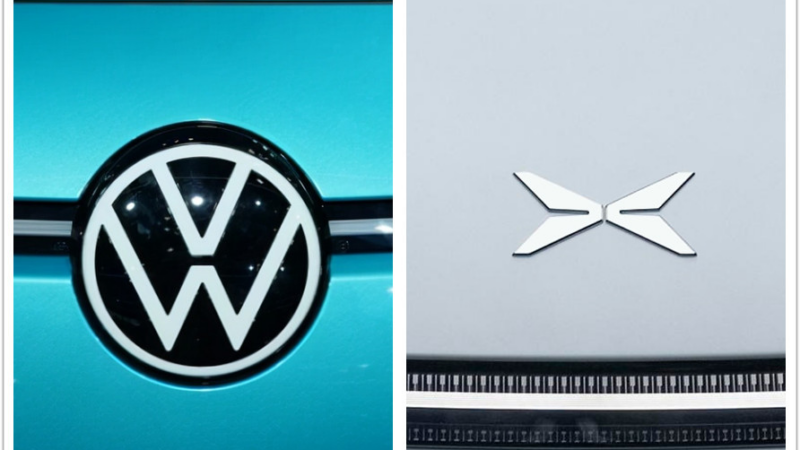
Volkswagen and Xpeng are taking their relationship to the next level. In a strategic move that signals a major shift in the industry, the two companies announced they will expand their jointly developed electronic and electrical (E/E) architecture to Volkswagen’s gasoline and hybrid models in China.
Beginning in 2027, the advanced China Electrical Architecture (CEA) platform, born from a partnership between the German legacy automaker and the Chinese electric vehicle powerhouse, will become the digital backbone for VW’s entire locally produced lineup. It’s a clear statement that cutting-edge tech is no longer just for EVs.
A New Brain for Every Car
So, what is the CEA platform? Think of it as a vehicle’s central nervous system. It replaces a complex web of dozens of individual electronic control units (ECUs) with a single, high-performance central computer. This simplified, software-defined approach is a huge leap forward.
For drivers, it means more advanced and reliable driver assistance systems (ADAS), a smarter in-car AI assistant, and fast, stable over-the-air (OTA) updates for the entire vehicle. Your car can get better over time with new features and fixes, just like a smartphone. This not only makes the car more sustainable but also helps it hold its value long-term.
Smart Tech Meets Smart Business
This move is about more than just cool technology. It’s a brilliant strategic play by Volkswagen. The company’s gasoline-powered cars, built on its proven MQB platform, are still incredibly popular in China, accounting for roughly 90% of the 2 million vehicles the Volkswagen brand delivered there in 2024.
Ralf Brandstätter, VW’s chief for China, emphasized that advanced tech shouldn’t be reserved for a single powertrain. “Extending CEA across our strong portfolio of fuel-powered models will further consolidate our technological leadership in conventional vehicles,” he said. By standardizing the CEA platform across all models, Volkswagen Passenger Cars can achieve massive economies of scale, slash costs, and keep its gas and PHEV models competitive against tech-savvy local rivals. This protects its profitable core business while freeing up cash for future innovations.
He Xiaopeng, Chairman and CEO of Xpeng, called the agreement a “milestone” that reflects the deep trust and shared vision between the two brands. It’s a powerful acknowledgment from an automotive giant that the future of car technology is being forged by innovators in the EV space.
“For China, In China” Heats Up
This partnership is a prime example of Volkswagen’s “for China, in China” strategy in action. The automaker is pouring resources into local research and development, establishing the Volkswagen Group (China) Technology Co., Ltd. (VCTC) in Hefei to lead the charge. By aligning its software division, Cariad China, with VCTC, VW is building a nimble organization that can develop and deploy digital services tailored specifically for Chinese consumers.
Dr. Robert Cisek, CEO of Volkswagen Passenger Cars China, noted the dual benefits. Standardizing the CEA platform will speed up the rollout of digital services and OTA updates while the scale helps “further reduce costs and strengthen market competitiveness.”
Looking ahead, this shared architecture will be the foundation for VW’s aggressive push into the intelligent connected vehicle space starting in 2026. The group plans to have around 30 electrified models on the market in China by 2027, with that number growing to roughly 30 pure battery electric vehicles by 2030. This collaboration ensures that whether you buy a gasoline, hybrid, or all-electric VW, you’re getting a vehicle built for the future.