
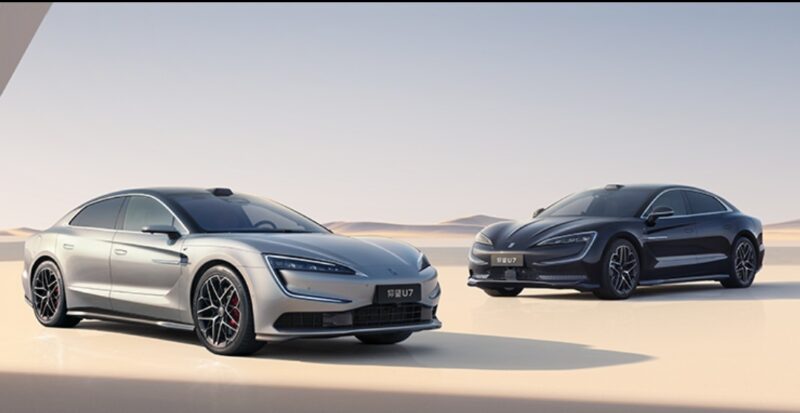
BYD just dropped a serious contender in the luxury sedan ring. The Yangwang U7, the first flagship sedan from BYD’s high-end Yangwang brand, has officially launched in China, and it’s packing some truly wild technology and performance figures. With a price tag ranging from 628,000 to 708,000 yuan (about 86,500 to 98,000 USD), it’s aimed squarely at legacy luxury automakers, but with a spec sheet that looks like it’s from a decade in the future.
The U7 comes in both pure EV and plug-in hybrid (PHEV) flavors, but the headlines are all about the raw power. The all-electric version is an absolute monster, and it’s clear BYD is not messing around.
| Metric | Value | Unit | Notes |
|---|---|---|---|
| 0–100 km/h (0–62 mph) | 2.9 | s | EV variant |
| Peak power | 960 | kW | Equivalent to 1,287 hp |
| Peak torque | 1,680 | Nm | Instant electric torque |
| Range (CLTC) | 720 | km | EV variant |
| Battery capacity (gross) | 135.5 | kWh | BYD Blade Battery |
| Max DC fast-charge rate | 500 | kW | 30-80% in 20 min (dual-gun charging) |
| Dimensions (L/W/H) | 5265/1998/1517 | mm | EV Variant |
| Starting price (local market) | ¥628,000 | CNY | Approx. 86,500 USD |
Mind-Bending Power and an Intelligent Ride
Let’s get straight to it. The Yangwang U7’s all-electric model uses four electric motors, one for each wheel, making a combined 960 kW (1,287 hp). That’s enough to rocket this big luxury sedan from 0 to 100 km/h in just 2.9 seconds. It’s a silent land missile with a top speed of 270 km/h. This quad-motor layout is part of BYD’s “e4” platform, which does more than just provide brutal acceleration. It allows for insane agility, including parallel lateral movement (crab walking) and tank turns on the spot. With intelligent rear-wheel steering, its turning radius is just 4.85 meters, making it feel much smaller than it is.
The real party trick is the DiSus-Z suspension system. Instead of old-school hydraulic shocks, it uses magnetic suspension motors. It pairs with the car’s lidar and cameras to read the road surface half a second ahead, actively adjusting height and damping for a perfectly smooth ride. It even has a survival mode. If the car detects a flat tire, it lifts the affected wheel and lets you drive on the other three at up to 80 km/h for 30 km. It’s a wild piece of engineering that feels like it’s floating on magnets.
Brains to Match the Brawn
The U7 is loaded with one of the most advanced sensor suites on the market. Dubbed the “God’s Eye” A advanced driving assistance system, it uses three lidars, five millimeter-wave radars, and 13 cameras. This hardware gives the U7 L2+ automated driving capabilities without needing high-precision maps, a major leg up on competitors that depend on them.
For those who want flexibility, there’s a PHEV version. It combines the four electric motors with a 2.0T engine, which happens to be the first horizontally-opposed (boxer) engine developed in China. It offers a 200 km pure electric range and a total comprehensive range of 1,000 km, making it a powerful and efficient grand tourer. This makes it a great option for those not quite ready to go full electric, similar to other impressive hybrids like the 650 hp Voyah Passion L.
A Cabin Built for a Tech Billionaire
Inside, the U7 is just as futuristic. The “Star Ring Cockpit” is covered in Nappa leather, real wood, and carbon fiber. Screens are everywhere. A huge 12.8-inch curved OLED sits in the center, powered by BYD’s latest DiLink 150 system and a 4-nanometer chip. There’s also a 23.6-inch instrument panel for the driver, an AR-HUD, screens for the rear passengers, and even a small entertainment screen for the copilot.
Comfort is clearly a priority. The front seats have 20-way adjustment, heating, ventilation, and even a hot stone massage function. The four-seat layout gives rear passengers independent seats with electric leg rests, turning the back into a first-class lounge. Paired with a 23-speaker Dynaudio sound system, the U7 promises to be an incredibly comfortable car for both daily driving and long-distance travel.
The Yangwang U7 isn’t just a car, it’s a bold declaration from BYD. It proves that Chinese automakers are not just competing on price anymore, they are pushing the boundaries of performance, technology, and luxury.