
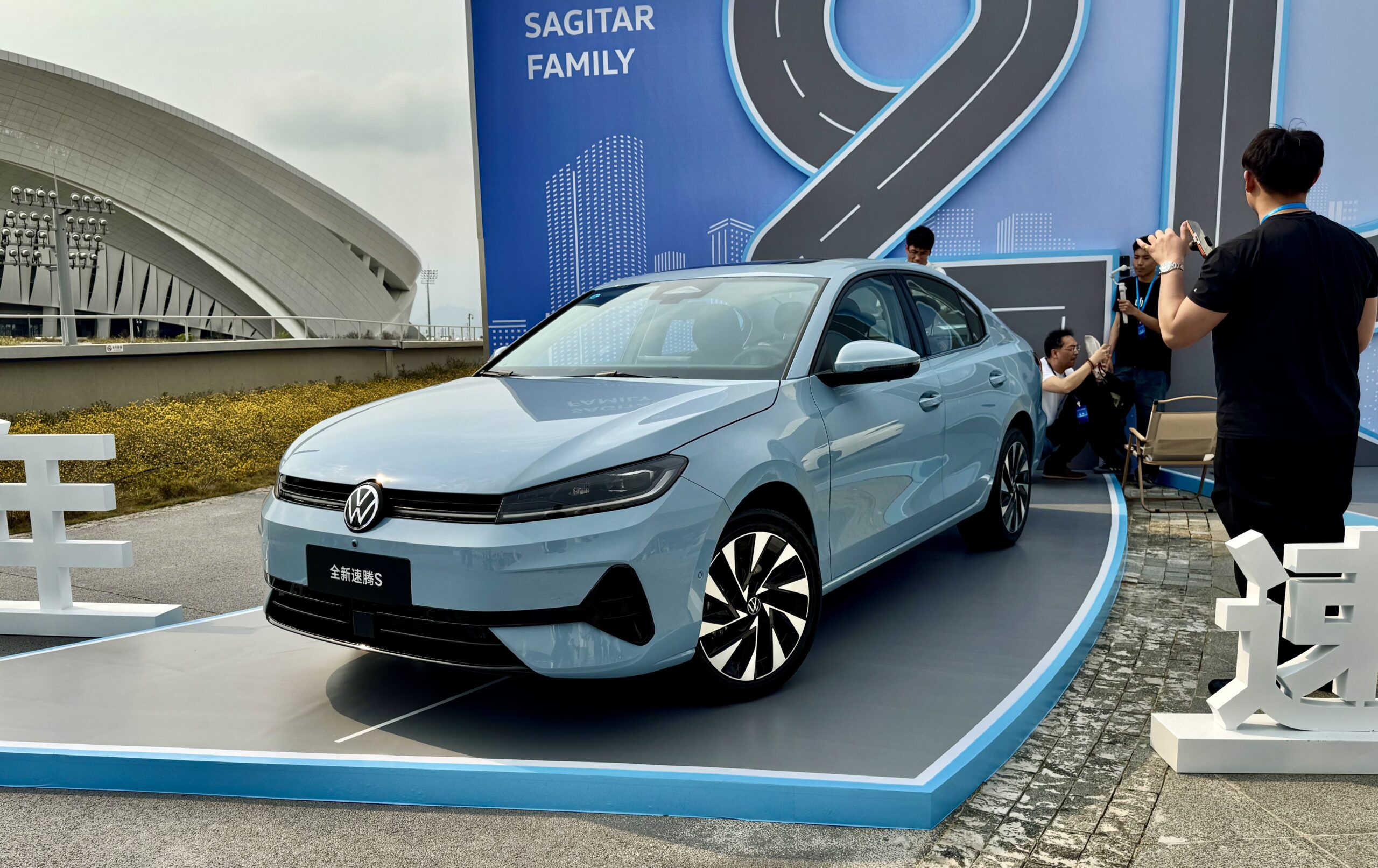
On March 31, FAW-Volkswagen held a spring product launch event, unveiling five new models in a single showcase.
The five models include the all-new Sagitar S, Magotan 35th Anniversary Edition, the all-new Tavendor, as well as PHEV versions of the Magotan and Tayron L.
Among them, the three ICE models announced official prices at the event:
The all-new Sagitar S is priced at RMB 79,800 ($11,545) for the 1.5L Fashion Edition, RMB 87,800 ($12,702) for the 1.5L Comfort Fashion Edition, RMB 92,800 ($13,425) for the 1.5L Elite Edition, and RMB 105,800 ($15,314) for the top-spec 300TSI Luxury Edition.
The all-new Tavendor is priced at RMB 245,900 ($35,588) for the 450 AWD Premium version and RMB 266,900 ($38,627) for the 450 AWD Flagship version.
The Magotan 35th Anniversary Edition is priced at RMB 179,900 ($26,027).
The PHEV versions of the Magotan and Tayron L were first unveiled at last year’s Guangzhou Auto Show. This marks their second appearance, but pricing will only be announced in the second quarter of this year.
Notably, for PHEV models, Volkswagen introduced a “three guarantees” policy, claiming to fully underwrite the core electric powertrain system.
Beyond its established and mature engine lineup, FAW-Volkswagen aimed to emphasize two key themes at this event: “intelligence parity between ICE and EV” and “parallel development of ICE and electrification.”
However, judging from the launch cadence, ICE vehicles still enjoy higher priority.
In China, the ICE lineup remains Volkswagen’s core sales pillar. In February, the top six best-selling models were predominantly ICE vehicles, including the Sagitar and Tayron L.
How Volkswagen plans to stabilize its ICE base through facelifts, and how it intends to achieve breakthroughs in the NEV sector, remain key areas of market focus.
To answer these questions, it is necessary to examine what FAW-Volkswagen communicated at the event regarding its dual strategy of intelligence parity and co-development.
The newly launched Sagitar S and Tavendor share a clear common feature: support for relatively advanced driver assistance, parking assistance, and AI-powered smart cockpits.
Starting with the Sagitar S, according to Volkswagen brand executive director Sheng Yehua, the vehicle supports full-speed adaptive cruise control, emergency steering assist with AEB, and remote parking assistance. Reports suggest this solution is sourced from Mobileye.
For comparison, similarly priced domestic NEV models such as the BYD Qin PLUS Intelligent Driving Edition come standard with features including automatic emergency braking, lane-change assist, full-speed adaptive cruise control, and narrow-road assistance, enabling L2-level highway NOA navigation.
The recently launched Leapmotor A10 505 LiDAR Edition, priced at RMB 86,800 ($12,555), even features LiDAR and supports urban NOA navigation.
It is worth noting that for the Sagitar S, highway NOA capability is only available from the near top-spec variant.
In terms of the cockpit, the Sagitar S integrates Volkswagen’s in-house AI along with DeepSeek and Doubao large models, supporting up to 20 seconds of continuous voice commands across nearly 800 vehicle control functions, and can recognize regional dialects such as Sichuanese and Cantonese.
The all-new Tavendor, positioned at a higher price and segment, not only adopts a similar smart cockpit solution but also represents the highest level of driver assistance among these ICE models.
Unlike the Sagitar S, the Tavendor’s driver assistance system is co-developed with Zhuoyu, featuring an 8-megapixel forward-facing stereo camera with a claimed detection range of 212 meters, supporting end-to-end highway NOA navigation.
Compared with similarly priced ICE vehicles—especially joint-venture products—models equipped with advanced NOA capabilities remain rare.
However, within the domestic NEV segment, most SUVs priced around RMB 250,000 ($36,170) are already equipped with LiDAR-based advanced driver assistance systems, such as Li Auto i6, Xiaomi YU7, and IM LS6, where the Tavendor’s advantages appear less pronounced.
Overall, from the perspective of “intelligence parity,” FAW-Volkswagen has indeed elevated the intelligence level of its ICE vehicles.
However, likely constrained by traditional ICE architectures, relatively few models currently support full-scenario NOA navigation. Examples that do—such as the new Audi A5L and Q5L—are equipped with Huawei Qiankun ADS 3.0.
These models achieve full-scenario NOA capability due to the adoption of high-power mild-hybrid systems and advanced electrical architectures.
In other words, higher-level driver assistance requires stronger electrical support.
This provides a theoretical foundation for the PHEV versions of the Magotan and Tayron L, which feature larger battery packs and can support broader assisted driving scenarios.
The PHEV versions of the Magotan and Tayron L were first unveiled on the opening day of last year’s Guangzhou Auto Show.
With the addition of electric motors and battery packs, these models achieve fuel consumption as low as 3.65L/100 km, a combined range of up to 1,440 km, and a certain level of pure electric driving capability.
More importantly, the PHEV versions demonstrate broader scenario coverage in intelligent driving compared with the ICE models mentioned above.
In addition to end-to-end highway NOA, these PHEV models support cross-floor memory parking (with a memory range of up to 2 km), 100-meter trajectory-based reversing, and remote parking—features not highlighted for the Sagitar S and Tavendor.
Pricing for these PHEV models remains unknown, but based on their capabilities, full-scenario advanced driver assistance is no longer limited to premium vehicles. Models such as the Xpeng MONA M03 and Geely Galaxy Xingyao 8 also offer strong intelligent driving capabilities in their higher trims.
FAW-Volkswagen’s messaging around “intelligence parity” and “co-development” is supported by tangible actions.
From this event, both the PHEV Magotan and Tayron L, as well as the Sagitar S and Tavendor with highway NOA capabilities, represent outcomes of this new strategy.
However, looking at the broader Chinese market, according to CPCA data, more than 100 new models were launched between January and March 2026, many with significant improvements in driver assistance.
For FAW-Volkswagen, competition in both electrification and intelligent driving remains intense. The two PHEV models showcased will not reach the market until the second quarter.
In February, the Volkswagen brand sold over 100,000 units in China, ranking first.
Most of this volume was supported by traditional ICE models such as the Sagitar, Tayron, and Magotan, while NEV performance remained modest—for example, the ID.3 sold only 306 units that month.
How to achieve breakthroughs in intelligence and electrification remains a key challenge.
At present, FAW-Volkswagen’s approach is to introduce more “electrified-feeling” PHEV products while delivering more mature driver assistance and smart cockpit solutions.
In 2026, joint-venture brands are mounting a broader counteroffensive in the NEV market, with SAIC Volkswagen recently launching products such as the ID.ERA 9X.
Whether FAW-Volkswagen’s new strategy will succeed ultimately depends on market validation.
Subscribe to get the latest posts sent to your email.