
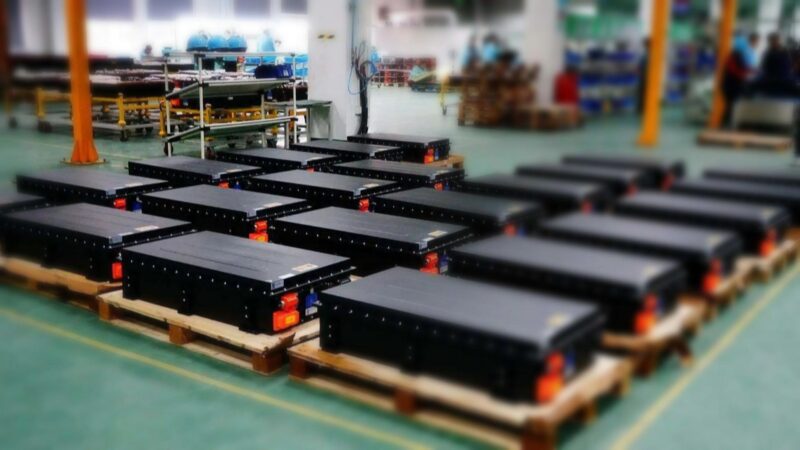
Volkswagen-backed Chinese battery giant Gotion High-Tech is making serious waves in the EV world, announcing that its cutting-edge, all-solid-state “Jinshi Battery” has officially entered pilot-scale production. This isn’t just a small step; it’s a giant leap towards bringing solid-state battery tech to the masses in China. The company isn’t stopping there, either, with design work already underway for a massive 2 GWh mass production line. This move signals a significant push to industrialize a technology that could redefine electric vehicles.
The Jinshi Battery: Eight Years in the Making
Born from eight years of dedicated research and development, the Jinshi Battery was first revealed in May 2024. What makes it so special, you ask? It leverages a sulfide-based solid electrolyte, packed with clever material innovations. Think micronized electrolytes, ultra-thin coated single-crystal cathodes, and three-dimensional mesoporous silicon anodes. The result? An impressive energy density of 350 Wh/kg, which is about 40% more potent than your average ternary lithium battery. And for those worried about safety, Gotion has put it through the wringer, with rigorous tests including a 200°C thermal chamber, nail penetration, and crush tests.
Breaking Barriers: Technical Triumphs and Future Plans
Gotion isn’t just talking the talk, they’re walking the walk. Their initial 0.2 GWh pilot line boasts 100% localization of core production equipment and a consistently high 90% yield rate. They’ve also fine-tuned the chemistry, boosting the ionic conductivity of their sulfide electrolyte by roughly 60% and slashing cell preload pressure by 90%. This means better consistency and happier batteries. After a year of real-world endurance validation, prototypes showed a staggering 150% increase in cell capacity compared to earlier versions. This kind of progress is what truly excites us in the EV space.
When it comes to longevity, the Jinshi Battery promises over 3,000 charge cycles and a projected one-million-kilometer lifespan. The full pack system hits an energy density of 280 Wh/kg, translating to an estimated 1,000 km driving range on a single charge. And forget about range anxiety in extreme weather, these batteries perform stably from -20°C to 85°C. Plus, prototype vehicles rocking these cells have already tackled over 10,000 km of on-road testing, proving their mettle where it counts.
While Gotion hasn’t spilled the beans on the exact investment or timeline for the upcoming 2 GWh production line, industry insiders are whispering about costs in the ballpark of 1.5-2 billion yuan (205-273 million USD) per GWh, drawing comparisons to semi-solid battery projects. The company has its sights set on integrating these batteries into vehicles on a small scale by 2027, with broader mass production targeted for 2030.
Beyond Roads: eVTOLs and Global Ambitions
Gotion isn’t just looking at cars; they’re also teaming up with Chinese eVTOL developer EHang to bring solid-state technology to low-altitude aircraft. This opens up entirely new possibilities for urban air mobility. Industry observers are quick to note that Gotion’s rapid advancements could significantly close the gap between China and leading Japanese and Korean battery manufacturers. However, the true test for large-scale commercialization will hinge on mastering cost control and ensuring interface stability. Ultimately, the future of Chinese EVs looks brighter than ever, with advancements like the Jinshi Battery leading the charge.
China’s EV market is a hotbed of innovation. Companies are constantly pushing boundaries, from BYD’s luxurious offerings to Xiaomi’s rapid ascent in the automotive world. The sheer scale of development, evidenced by millions of data points on new EVs and extensive charging infrastructure, clearly shows a nation dedicated to electrification. Even traditional automakers like Volkswagen are deeply entrenched in the Chinese market, tapping into local tech for their future EV lineups. This relentless pursuit of progress makes China a fascinating space in the global automotive landscape. We’re talking about everything from powerhouses like the BYD Yangwang U7 to nimble urban runabouts like the NIO Firefly, all benefiting from cutting-edge battery technology.
This vibrant marketplace also sees a dynamic interplay of established brands and ambitious newcomers. The ongoing race for market share means constant innovation, with everything from breakthroughs in charging technology to advancements in autonomous driving. It’s a landscape where companies like Xpeng expanding into Europe and Leapmotor forming strategic partnerships. Clearly, the competition is fierce, but the ultimate winner will be the consumer, with more efficient, safer, and higher-performing EVs hitting the roads and skies.