
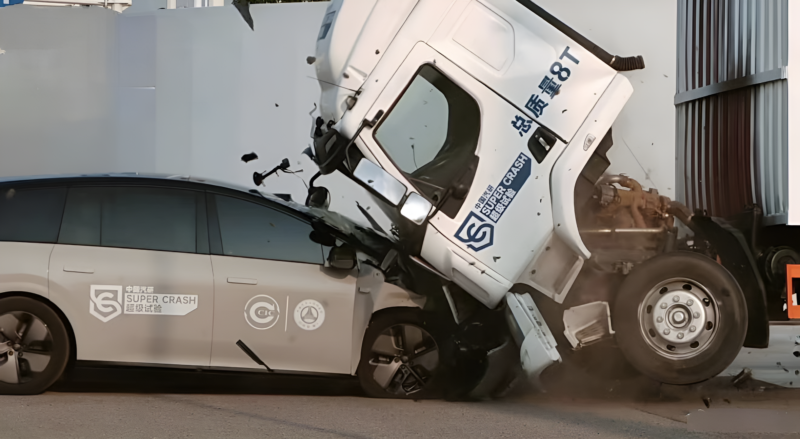
In the dynamic world of Chinese EVs, safety is a hot topic, and Li Auto recently found itself in the spotlight. Following a crash test video that went viral after the July 29 launch of its new i8 SUV, the automaker issued a formal clarification. The video, depicting a high-speed frontal collision between the i8 and a heavy-duty Chenglong truck, showed the i8 with minimal deformation, while the truck’s cab suffered significant damage. This sparked a lively debate online, leading to Li Auto’s August 3 statement on Weibo.
The Controversial Crash Test
The crash test footage ignited public discussion, particularly after Chenglong Truck, a subsidiary of Dongfeng Liuzhou Motor, weighed in on August 1. Chenglong argued that the test conditions weren’t representative of real-world traffic. They emphasized the need for rational crash analysis and reiterated their commitment to safety in the commercial vehicle sector. Dongfeng Group, Chenglong’s parent company, also expressed concern over their brand’s portrayal, calling it “involution-style competition” and advocating for fair industry practices.
Li Auto’s subsequent statement clarified that the test was conducted by the state-owned China Automotive Engineering Research Institute Co., Ltd., a recognized national testing authority. The company explained the test aimed to evaluate the i8’s ability to withstand collisions with larger vehicles like trucks, a scenario increasingly relevant on China’s busy highways.
i8 Safety Features Under Scrutiny
During the impact, the i8 reportedly maintained structural integrity, with no deformation to critical components such as the A, B, and C-pillars or door beams. All nine airbags deployed flawlessly, and there were no signs of battery pack leakage or thermal issues. The doors automatically unlocked, and handles extended as designed, showcasing the thoughtful engineering behind the vehicle’s safety systems. The i8’s “short overhang” design, originally conceived to maximize cabin space, also proved effective in mitigating impact forces. This highlights the intricate balance between innovative design and robust safety that modern EV manufacturers strive for. For an in-depth look at other innovative designs in the EV market, check out how the Xiaomi Yu7’s structure is a masterclass in EV engineering.
Li Auto further clarified that the Chenglong vehicle used in the video was a used truck, acquired and modified specifically to serve as a movable crash barrier. The company stressed that the test was not intended to assess the truck’s safety performance. Acknowledging the unexpected online reaction, Li Auto expressed regret for inadvertently drawing Chenglong into public controversy, emphasizing that the two companies operate in distinct vehicle markets with no direct competition.
Setting New Safety Benchmarks
Safety is paramount, and the i8 was developed to meet China’s most recent regulatory standards for front, side, and and rear crash protection. It aims for the highest ratings under both the China New Car Assessment Program (C-NCAP Version 24) and the China Insurance Automotive Safety Index (C-IASI Version 23). The company states the vehicle underwent over 100 internal crash test scenarios, including rigorous “truck pinching” simulations, further cementing its commitment to passenger safety. This dedication to safety across various scenarios is a consistent theme in the industry, as seen with companies like BYD which are pushing for zero defects in battery production. Find out more about BYD’s push for zero defects as battery production soars.
Li Auto reinforced its commitment to automotive safety, expressing a willingness to collaborate with industry stakeholders to enhance crash resilience and vehicle protection standards. With the rapid evolution of the EV market, ensuring robust safety measures is more crucial than ever. With China’s EV market surging and new innovations constantly emerging, it is important to stay updated with the latest trends. Explore insights into China’s auto market, a mix of bold launches and market realities as the industry continues to grow.
For more detailed insights on how Chinese automakers are navigating brand perception and industry practices, you can read about how Chinese automakers fight back against PR attacks.