
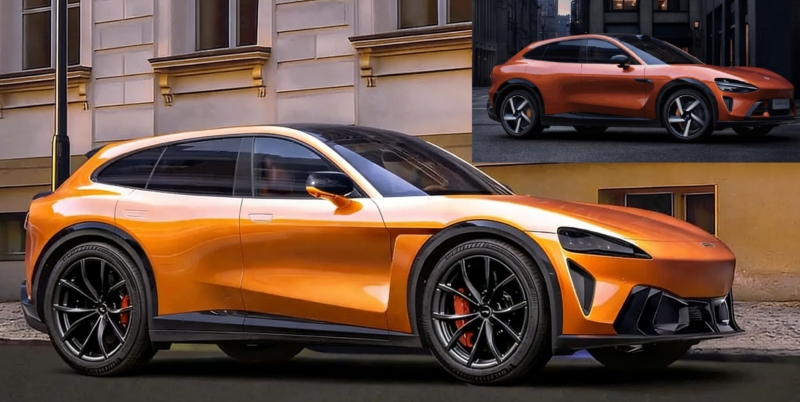
You’d be forgiven for doing a double take when you see the McLaren P47 and the Xiaomi YU7 side by side. These two SUVs, one a hybrid supercar and the other a tech-packed EV, share a striking resemblance that’s frankly uncanny. From the sleek roofline and side profile to the hidden door handles and rear tail lights, the design similarities are clear. While the McLaren P47 we are discussing today is based on Motor1 renderings and may not be the final production model, and Xiaomi’s YU7 GT promises even sportier specs, the standard YU7 offers a fascinating comparison.
Meet the McLaren P47
McLaren, a brand synonymous with raw supercar performance, is venturing into new territory: the SUV market. The P47 is a four-door, five-seat hybrid, designed to keep that supercar soul alive. It boasts a low, wide stance, aerodynamic curves, and distinctive split-flush headlights. Its side profile and sleek roofline echo the Xiaomi YU7, and those rear tail lights definitely complete the look. Reportedly larger than a Porsche Cayenne Turbo GT and featuring 24-inch wheels, this beast is described by dealers who saw a clay model as “sculpted and muscular,” with deep scallops for aero performance and a sleek greenhouse. Dual exhaust tips hint at its sporty, exotic nature. Though the final production version might differ, the rendered vision certainly turns heads.
Meet the Xiaomi YU7
On the other side of the ring, we have the Xiaomi YU7, a fully electric SUV built on Xiaomi’s Modena platform. This isn’t just any EV; it’s a rolling tech hub. Measuring 4,999 mm long, 1,996 mm wide, and 1,608 mm high, with a 3,000 mm wheelbase, the YU7 offers a roomy experience. Its power outputs range from 235 kW (315 hp) to a blistering 508 kW (approximately 681 hp), depending on whether you opt for the Standard, Pro, or Max trim. Battery capacities span 96.3-101.7 kWh, translating to a CLTC-rated range of 760-835 km. Inside, you’ll find a panoramic HyperVision display, adaptive massage seats, and advanced ADAS hardware including LiDAR, radar, and cameras. Thanks to its 800V fast-charging architecture, daily commutes or long journeys are effortless.
Pricing for the YU7 trims are quite competitive too:
- Standard: approximately 35,000 USD
- Pro: approximately 39,000 USD
- Max: approximately 46,000 USD
Powertrain Perspectives
These SUV lookalikes have wildly different hearts. The McLaren P47 is all about that hybrid V8 power, designed to deliver supercar-like performance on demand. We are still waiting on official 0-100 km/h times and range figures, but it’s clear this SUV is built for enthusiasts who crave raw power and exotic performance.
Meanwhile, the Xiaomi YU7 is 100% electric. With power ranging from 235 kW to 508 kW, it can sprint from 0-100 km/h in as little as 3.2 seconds for the Max trim, or a still-impressive 5.9 seconds for the Standard model. Its CLTC range from 760-835 km and focus on tech make it a practical, forward-thinking option for everyday driving.
Design Details
The P47’s aggressive, sporty styling, low roofline, and flowing side profile are truly striking, and it is here where the resemblance to the YU7 really shines. The slim, horizontal rear tail lights stretching across the tailgate further cement this visual link. The YU7, on the other hand, brilliantly blends aerodynamic SUV proportions with cutting-edge EV aesthetics. Its smart design features include hidden door handles, panoramic displays, and advanced driver-assistance systems. While the P47 aims to be a supercar in SUV form, the YU7 achieves a high-tech electric presence with a touch of shared style.
Final Thoughts
Despite the astonishing visual parallels in profile, roofline, and tail lights, the McLaren P47 and Xiaomi YU7 are ultimately distinct machines with different purposes. McLaren’s P47, as rendered, promises hybrid supercar performance in a four-door SUV, with an anticipated price tag in the low 300,000 USD range and a 2028 release. The Xiaomi YU7 delivers a fully electric, tech-rich SUV experience for daily driving, starting at around 35,000 USD. It’s a fascinating clash of philosophies. Even if McLaren’s final design shifts a bit, the current resemblance is enough to make anyone pause. It poses an intriguing question: is that a multi-hundred-thousand-dollar hybrid SUV, or a cleverly styled, high-tech Chinese EV? The shared aesthetics speak volumes about where modern SUV design is heading, proving that even brands from different automotive worlds can find themselves on surprisingly similar design paths.