
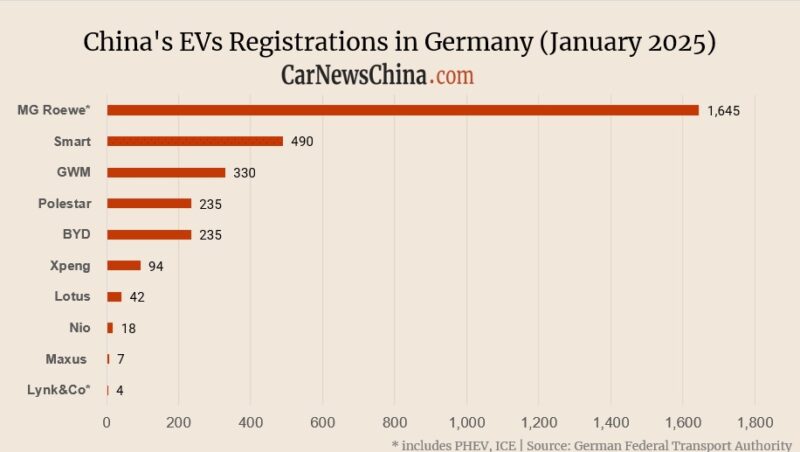
January was a fascinating month for Chinese electric vehicle brands in Germany. While the overall car market saw a slight dip, EV and plug-in hybrid registrations shot up, proving where the momentum is. It wasn’t a clean sweep for Chinese automakers, though. The results show a market in flux, with some brands celebrating huge gains while others, including Tesla, faced a tough start to the year.
MG and Great Wall Motor Lead the Charge
SAIC-owned MG took the crown among Chinese brands, registering 1,645 vehicles. That’s an impressive 84% jump compared to the same time last year, even with a slight slowdown from December. This success comes despite a major hurdle. As a state-owned enterprise, SAIC was hit with the highest EU import duties, facing a staggering 45.3% total tariff on its vehicles like the popular MG4 EV.
Great Wall Motor (GWM) had an even more explosive start, with its Ora brand seeing a 267% year-over-year surge by registering 330 cars. It shows that GWM’s quirky and stylish EVs are finding their audience in a competitive market.
Steady Growth for BYD, Polestar, and Xpeng
BYD and Geely’s Polestar both ended the month with 235 registrations each. For BYD, this marks a solid 69% increase from last year, continuing its steady push into Europe. Polestar, with its EVs produced in Geely’s Chinese plants, grew by 114%, showing its premium electric performance cars are gaining traction.
Meanwhile, Volkswagen-backed Xpeng registered 94 cars. Since Xpeng just began German deliveries in mid-2024, there’s no year-over-year comparison yet, but the brand is building its presence. Its deepening partnership with a German auto giant like Volkswagen is a strategic advantage that will be crucial for its long-term growth in Europe.
A Tough Month for Nio and Tesla
It wasn’t good news for everyone. Nio saw its registrations drop to just 18 vehicles, a 33% decline from the previous year. This slowdown comes as the company faces a 30.7% total tariff from the EU. It’s a tough spot for a brand known for its premium features and innovative battery-swapping tech. While the main brand struggles, its strategy with sub-brands like the Onvo L90 Black Knight may be key to future growth.
For perspective, it’s worth noting that Tesla also had a rough January. The American EV giant registered 1,277 vehicles, a sharp 59.5% drop compared to last year. This highlights the volatility of the German market and the intensifying competition from both legacy automakers and new Chinese challengers.
The Shadow of EU Tariffs
The backdrop to all these figures is the EU’s decision to impose significant countervailing duties on Chinese BEVs, which took effect in October 2024. These tariffs are here to stay for the next five years and create a complex competitive landscape.
Here’s a quick breakdown of the additional duties on top of the standard 10% tariff:
- SAIC (MG): 37.6%
- Geely (Polestar): 18.8%
- BYD: 17.0%
- Nio, Xpeng, and others: 20.7%
These numbers are more than just statistics. They directly impact the final sticker price for German consumers and challenge the pricing strategies of each brand. How these companies navigate these duties, whether by absorbing the cost, adjusting production, or highlighting features to justify the price, will likely separate the winners from the losers in the coming years.
The German market is a key battleground, and January’s results show that while Chinese EV makers are here to play, the game is getting harder.