
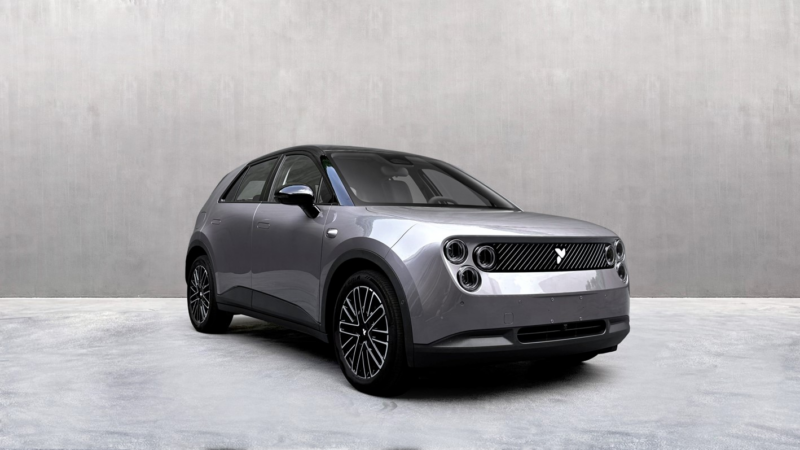
Nio’s compact EV brand, Firefly, is already getting a shot in the arm. Recent government filings show a more powerful version is on its way, adding a little more spice to an already popular model. But the bigger story is what’s happening with its battery strategy, which highlights a major strategic pivot for Nio.
Since launching in April, the Firefly has been a solid performer, helping bolster Nio’s impressive sales figures. But things move fast in the Chinese EV world, and standing still isn’t an option.
A Little More Pep
So what’s new? The updated Firefly will get a new electric motor built by Nio’s own power technology division. It boosts output to 120 kW (161 hp), a nice 20 hp jump from the current 105 kW (141 hp) motor. While the design and dimensions are staying the same, that extra power should make the featherlight EV feel even zippier off the line. For a car likely to spend most of its time darting through city streets, a bit more responsiveness is always welcome.
| Metric | Value (Current Model) | Value (Updated Model) | Notes |
|---|---|---|---|
| Peak power | 105 kW (141 hp) | 120 kW (161 hp) | Permanent magnet synchronous motor |
| Peak torque | 200 Nm | — | Current model spec |
| Top speed | 150 km/h | — | Current model spec |
| Range (CLTC) | 420 km | — | Based on the 42.1 kWh battery |
| Battery capacity | 42.1 kWh | TBA | A >50% larger pack is planned for the future |
| Dimensions (L/W/H) | 4003/1781/1557 mm | Unchanged | Compact city-friendly footprint |
The Real Story: A Battery Strategy Shift
The powertrain update is nice, but the real headline is about the battery. Nio’s founder and CEO, William Li, recently confirmed that future Firefly models won’t just get a performance lift. they’ll get a much larger battery pack, with at least a 50% capacity increase on the horizon.
That’s great news for range anxiety. But he also dropped a bombshell. Firefly will not use CATL’s well-known Chocolate battery swap system.
Here’s where it gets interesting for anyone following the Chinese EV supply chain. Nio and CATL, the world’s largest battery maker, announced a major strategic partnership back in March 2025. It even included a $250 million investment from CATL into Nio’s energy division. The plan seemed to be for Firefly to leverage CATL’s swap stations, giving it a massive infrastructure footprint from day one. That plan has changed.
Li explained it’s a technical problem. Firefly’s batteries are liquid-cooled, while CATL’s Chocolate swap stations are designed for air-cooled battery packs. They simply aren’t compatible. As a result, Firefly will stick to Nio’s own fifth-generation charging and swapping stations.
What This Means for Drivers
For anyone with a Firefly on their shopping list, this creates a classic trade-off. On one hand, Nio is clearly committed to improving the car’s core technology, from its motor to future battery capacity. Sales are already strong, with the brand contributing nearly 6,000 units to Nio’s 40,397 deliveries in October 2025, which reflect strong EV Registrations.
On the other hand, relying exclusively on Nio’s proprietary swap network could present a challenge. While Nio is a pioneer in battery swapping, its network is still growing and is much smaller than what CATL could have offered. For a while, the battery swap experience for Firefly owners might not be as seamless as they’d hope, especially outside of major cities.
This move shows Nio is betting on itself and its own technology ecosystem, a bold play in the competitive China EV Marketplace. The upcoming, more powerful Firefly looks great on paper, but its real-world success will depend just as much on the growth of Nio’s charging infrastructure as it does on its performance. It’s part of a broader push, as Nio’s Firefly enters Greece, Denmark, Austria, and Portugal, expanding its overseas strategy.