
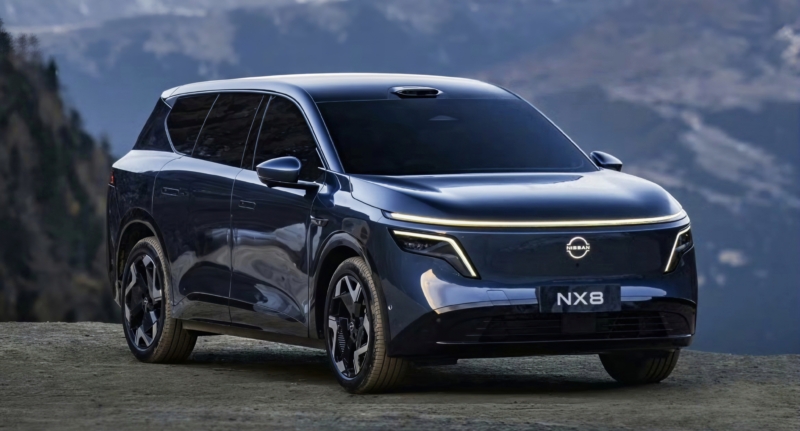
Nissan is stepping up its game in China’s incredibly competitive new energy vehicle market. They’re introducing the NX8, a brand new mid-to-large SUV developed under the Dongfeng Nissan badge, which has now been officially confirmed thanks to the latest Ministry of Industry and Information Technology (MIIT) filing.
The NX8 is going to be available as both a fully electric vehicle and a plug-in hybrid. This move shows Nissan’s solid commitment to reinforcing its position in China’s rapidly evolving EV landscape. After the MIIT filings went public, Nissan quickly dished out more information on the NX8.
This SUV is a big deal because it’s the first in Nissan’s N-series mid-to-large SUV lineup to rock an 800V high-voltage platform. Plus, it features CATL 5C ultra-fast charging technology, which is a significant leap forward for Nissan in its electrification journey.
According to the MIIT filing, the NX8 measures 4870 millimeters long, 1920 mm wide, and 1680 mm tall. It has a beefy 2917 mm wheelbase. Depending on how it’s configured, the curb weight rolls in between 2196 and 2245 kg, with a total vehicle mass of 2660 kg. When you put your foot down, this SUV can hit a reported top speed of 180 km/h.
Visually, the NX8 showcases Nissan’s evolved V-motion design language, giving it a fresh and modern look. The front really stands out with a 2.4-meter full-width “star ring” light, a sleek, flat illuminated logo, and those sharp matrix-style headlamps. The door handles are neatly concealed for a smooth, unbroken profile, and the rear gets a quantum OLED taillight panel, which is made up of 2064 individual units, allowing for some cool customizable lighting patterns. The side panels keep things minimalist, with integrated designs that include hidden water channels and ultra-narrow panel gaps. You’ll also get to choose between substantial 19- and 20-inch wheel options.
Under the hood, the NX8 offers a couple of potent powertrain options. If you go for the full EV, you’ll get a single electric motor delivering either 215 kW or 250 kW of power. For those who want a blend of electric and gas, the plug-in hybrid variant pairs a 1.5-liter turbocharged internal combustion engine that kicks out 109 kW with a robust 195 kW electric motor. Both versions use Nissan’s next-generation lithium-iron phosphate “Yundun” battery. This battery is developed and packaged by Nissan to meet global standards and designed to handle a wide temperature range, from a frosty -30℃ to a scorching 60℃. Powering things further, the SUV also comes with advanced driver-assistance systems, including highway and urban navigation assistance (NOA) and full-scenario intelligent parking, complete with integrated lidar for pinpoint accuracy and enhanced safety.
Nissan’s Latest NEV Moves in China
Earlier in 2025, Dongfeng Nissan rolled out two other notable NEVs: the N7, a fully electric mid-size sedan, and the N6, a plug-in hybrid mid-size sedan. Both of these models are built on Dongfeng platforms and feature localized vehicle architecture, electrification systems, and smart vehicle software. The N7, for example, is priced between 119,900 and 149,900 yuan, which translates to roughly 16,650–20,800 USD. There are whispers that both the N6 and N7 have strong export potential, with Nissan eyeing markets in Southeast Asia and the Middle East. It’s a safe bet that the NX8 will follow this trend and also be considered for export, although we don’t have official launch timelines or pricing for those markets just yet.
Nissan’s strategy in China mirrors a broader trend we’re seeing with major automakers leveraging local partnerships and technologies to stay competitive. Take, for instance, Volkswagen’s deepening ties with Xpeng to integrate advanced EV tech. Even Chinese domestic brands are pushing boundaries, like BYD’s Yangwang U7 luxury sedan boasting 1287 hp and cutting-edge features. This aggressive push highlights just how vital the Chinese market is for innovation and sales in the EV space. It’s clear Nissan isn’t just making cars but tailoring them specifically for this dynamic environment, hoping to capture a significant piece of the pie.