
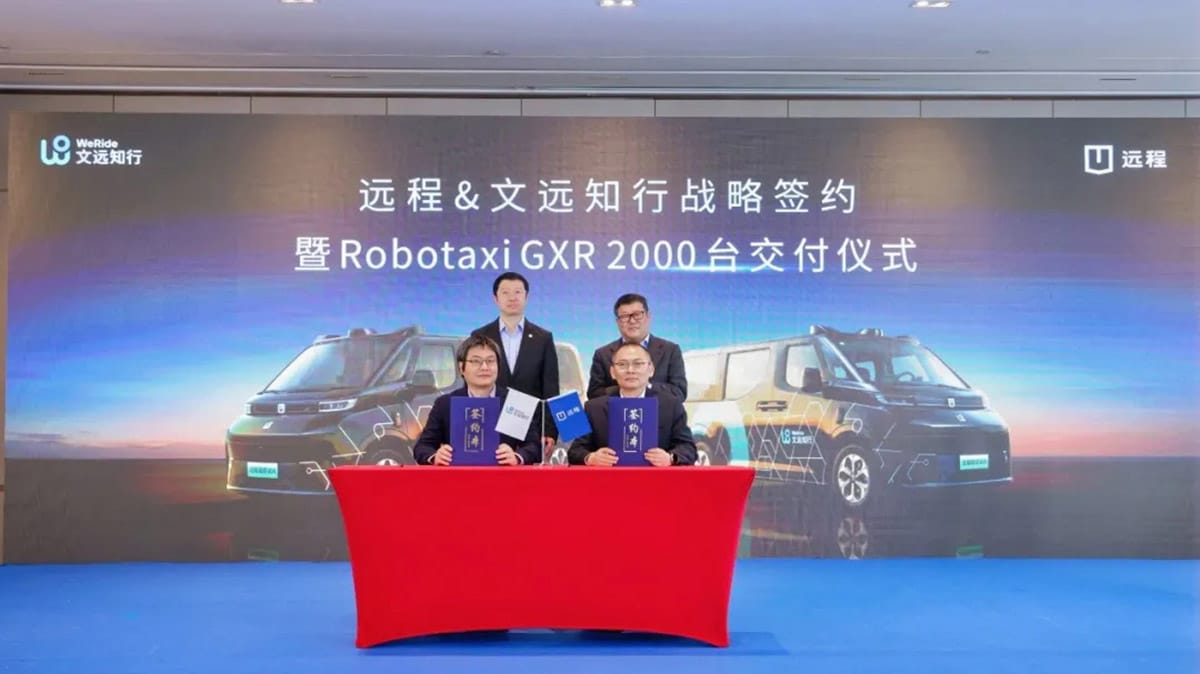
Get ready, because the future of mobility is arriving faster than you think. WeRide, the cutting-edge autonomous driving tech firm, is teaming up with Geely’s commercial vehicle division, Farizon, to bring a massive fleet of 2,000 factory-installed GXR robotaxis to the road by 2026. This isn’t just a concept; it’s a bold stride toward large-scale commercial operations for autonomous vehicles, and it’s happening right now. We’re talking about serious deployment, not just testing.
The upgraded GXR robotaxi is slated to roll off the production line in the third quarter of 2026. This aggressive timeline underscores WeRide’s commitment to making autonomous driving a reality for everyday use. Imagine hailing a ride that drives itself, smoothly and efficiently. The partnership leverages Farizon’s manufacturing prowess, slashing production time for each vehicle from an hour to under ten minutes. That’s a game-changer, allowing for rapid scaling.
Under the hood, so to speak, these new robotaxis will be equipped with WeRide’s latest autonomous driving system, GEN8. This sophisticated setup features a thousand-channel primary LiDAR, which is essentially the car’s advanced eyes. It captures incredibly detailed point cloud data, 17 times richer than before, and can spot obstacles up to an impressive 600 meters away. This enhanced perception is crucial for safe and reliable autonomous operation, especially in complex urban environments.
Beyond the tech, WeRide is also focused on making this future accessible. They anticipate a 15% reduction in the overall vehicle cost for the upgraded model. This focus on cost reduction is a hallmark of the Chinese EV market, where rapid innovation is often paired with aggressive pricing strategies to capture market share. It’s a dynamic landscape, with companies like BYD and Xiaomi constantly pushing the boundaries of what’s possible at different price points.
This isn’t just pie in the sky. WeRide’s robotaxi fleet has already grown significantly, reaching over 1,023 vehicles by January 2026. With the upcoming deliveries, their operational fleet will surpass 2,600 units this year alone. This steady expansion is a crucial step toward their ambitious goal of a global fleet numbering in the tens of thousands by 2030. They’re strategically targeting key markets, including China, the Middle East, Southeast Asia, and Europe, aiming to deploy their technology worldwide.
We’re already seeing promising signs of commercial viability. WeRide’s robotaxi service in Abu Dhabi is reportedly nearing break-even on a per-vehicle basis, a significant milestone. Plus, their trial operations in Singapore are set to open to the public soon. This real-world operational data is invaluable, providing insights into user adoption, operational efficiency, and the path to profitability. It’s a testament to the rapid pace of development in China’s autonomous driving sector, a field that continues to see intense competition and rapid advancements, much like the broader EV market where companies like NIO are making waves.
The synergy between WeRide’s intelligent driving systems and Farizon’s robust manufacturing capabilities is a powerful combination. It highlights a trend we’re seeing more and more: established automakers partnering with tech startups to accelerate the adoption of advanced technologies. This collaboration is set to reshape urban transportation, offering a glimpse into a future where autonomous vehicles are not just a novelty, but a fundamental part of our daily commute and logistics.