
The Wuling Hongguang Mini EV, China’s top-selling micro electric vehicle, is gearing up for a significant refresh. Recent filings with the Ministry of Industry and Information Technology (MIIT) reveal a design overhaul and revised dimensions, aiming to maintain its dominance in the burgeoning micro EV market. This update confirms Wuling’s ongoing commitment to a segment it has led for several years.
Unified Aesthetics and Striking Features
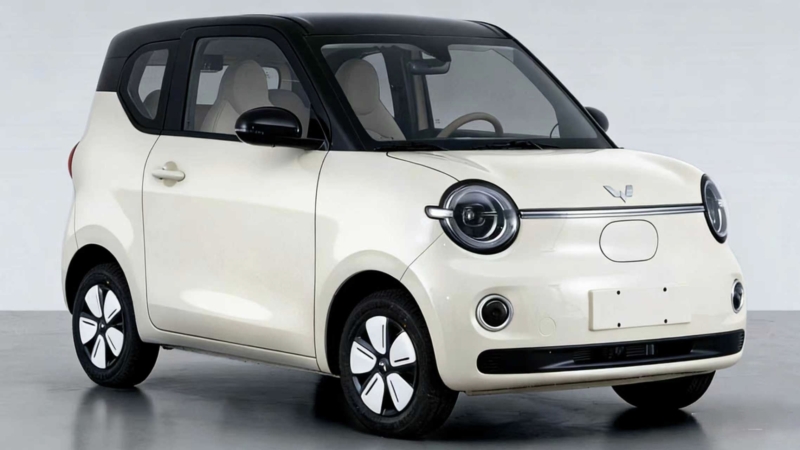
The most noticeable change in the refreshed Mini EV is its new visual identity. The vehicle now sports stylish circular headlights and taillights, creating a cohesive and contemporary look. A contrasting black floating roof adds a touch of modern flair, setting it apart from the outgoing model. This standardized design language will grace all six variants, including both two-door and four-door configurations, simplifying the lineup and strengthening brand consistency.
A Bit More Room, A Lot More Style
The five-door variant sees a slight increase in its footprint, measuring 3268 mm long, 1520 mm wide, and 1575 mm high. This is a subtle yet meaningful expansion compared to the current model’s 3256 mm length and 1510 mm width. Interestingly, the wheelbase for this version remains a steady 2190 mm, indicating that while external dimensions grow, its fundamental agility remains intact. For the three-door model, the dimensions are 3043 mm long, 1520 mm wide, and 1590 mm high, a minor adjustment from the previous 3064 x 1493 x 1614 mm. The three-door’s wheelbase is now 1965 mm, a slight reduction from 2010 mm.
Powertrain and Market Position
Under the hood, the updated Mini EV retains the reliable 30 kW electric motor from Liuzhou Saike, ensuring consistent performance with its predecessor. While the MIIT filing did not detail battery capacity or driving range updates, the previous models offered a CLTC-rated range of 205 km, with higher-capacity options extending to 301 km. These micro EVs utilize LFP batteries, a common and cost-effective choice in China’s EV market.
First launched in July 2020, the Wuling Hongguang Mini EV quickly captured the hearts of urban commuters with its compact size, practical layout, and accessible price point. Ranging from 38,800 yuan (about USD 5,470) to 55,800 yuan (about USD 7,860), it offers a compelling package for diverse budgets. Its success has spawned a competitive landscape, with rivals like the Chery QQ Ice Cream, Baojun E200, and Ora Black Cat vying for market share. However, the Mini EV’s consistent updates and thoughtful design choices continue to reinforce its position as a segment leader. Wuling’s strategy to focus on the micro EV segment appears to be paying off, with models like the five-door variant expanding its appeal and practicality for more consumers. The broader shift towards smaller, more efficient urban electric vehicles is a trend we’re seeing across the industry, with brands like Nio’s Firefly brand also making significant strides in this area. This refreshed Mini EV is a testament to the dynamic and rapidly evolving Chinese EV market.
The Micro EV Phenomenon and Beyond
The enduring popularity of the Wuling Hongguang Mini EV highlights a significant trend in the global automotive industry: the demand for affordable, practical, and efficient urban mobility solutions. Its success is not just about its attractive price point, but also its fit for dense city environments where space and maneuverability are paramount. The continued evolution of the Mini EV, with its contemporary styling and slight dimensional adjustments, is a smart move by Wuling to stay ahead in a fiercely competitive market. This commitment to innovation in the micro-EV space is reflective of the broader advancements occurring in China’s EV landscape, from battery technology to vehicle design. As China continues to lead in EV adoption, models like the Wuling Hongguang Mini EV will undoubtedly remain crucial in shaping the future of urban transportation, proving that sometimes, the smallest packages deliver the biggest impact. Other manufacturers are also pushing boundaries, with developments like CATL’s battery production innovations influencing the entire supply chain and making these vehicles more accessible. Additionally, the industry is constantly adapting to consumer needs, as seen with ongoing discussions about features like retractable door handles and their implications for safety and design.
| Metric | Value | Unit | Notes |
|---|---|---|---|
| Range (CLTC) | 205 km – 301 km | km | Available with higher-capacity packs |
| Battery chemistry | LFP | — | Cost-effective battery choice |
| Length (5-door) | 3268 | mm | Slight increase from current 3256 mm |
| Width (5-door) | 1520 | mm | Slight increase from current 1510 mm |
| Height (5-door) | 1575 | mm | Slight decrease from current 1578 mm |
| Wheelbase (5-door) | 2190 | mm | Unchanged |
| Length (3-door) | 3043 | mm | Slight decrease from current 3064 mm |
| Width (3-door) | 1520 | mm | Increase from current 1493 mm |
| Height (3-door) | 1590 | mm | Decrease from current 1614 mm |
| Wheelbase (3-door) | 1965 | mm | Decrease from current 2010 mm |
| Starting price (local market) | 38,800 – 55,800 | yuan | Approximately USD 5,470 – USD 7,860 |