
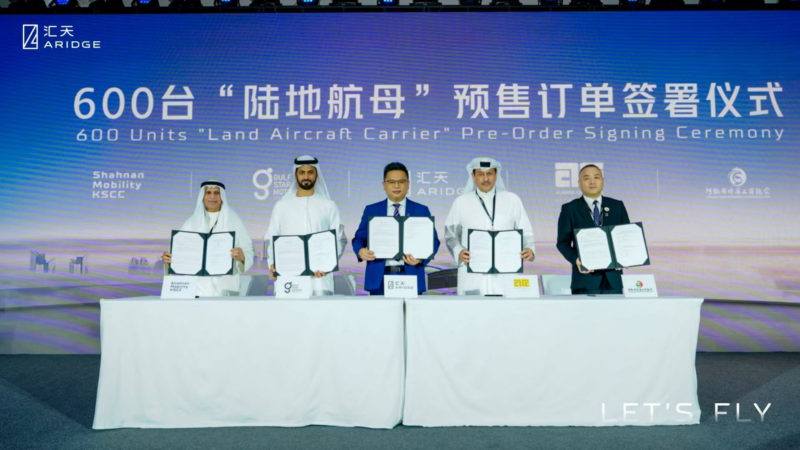
Xpeng Aeroht, the innovative flying car division of Xpeng, has just landed a monumental order: 600 units of its groundbreaking “Land Aircraft Carrier” in the Middle East. This isn’t just significant, it’s the biggest international bulk order ever seen in the nascent flying car industry, a clear sign that the future of personal mobility is truly taking off. The big news dropped during the company’s first international appreciation event in Dubai on October 12th.
Imagine witnessing a piece of tomorrow come alive today. That’s what happened at the Dubai event, where the “Land Aircraft Carrier” treated onlookers to its first overseas public manned flight demonstration. It was a moment that cemented Xpeng Aeroht’s vision for aerial mobility. The company inked crucial purchase agreements with powerhouse regional groups: UAE’s Ali & Sons Group, Qatar’s Almana Group, Kuwait’s AlSayer Group, and the UAE Chinese Business Council. These deals catapult Xpeng Aeroht’s global order book to an impressive 7,000 units.
Beyond dazzling demonstrations and hefty orders, Xpeng Aeroht also officially unveiled its new international brand, “ARIDGE.” This signals their serious intent to play a major role on the global stage. Adding to this momentum, the company announced that its cutting-edge flying car manufacturing facility in Guangzhou was fully operational by the end of September. This facility is the engine behind Xpeng Aeroht’s ambitious plan to kick off mass production and deliveries of the “Land Aircraft Carrier” by 2026, aiming to make it the first mass-produced flying car not just in China, but globally.
Meet the “Land Aircraft Carrier” and the A868
So, what exactly is this “Land Aircraft Carrier” that’s capturing so much attention? Priced under 2 million yuan (about 280,000 USD), it’s a truly unique machine. Sporting a 3-axis, 6-wheel design, this four-seater vehicle measures a substantial 5500mm long, 2000mm wide, and 2000mm high. You can actually drive this beast with a standard C-class license. Under the hood, or rather, underneath it, you’ll find an 800V silicon carbide range-extended power platform delivering over 1,000 kilometers of CLTC driving range and capable 6×6 all-wheel drive, offering serious ground capabilities.
But the magic truly happens with the flying module. Cleverly stored in the vehicle’s trunk, it charges while docked. A quick 18-minute charge takes it from 30% to 80%, and a fully charged and fueled vehicle can handle 5-6 flights. This flying module is essentially a large drone with four powerful propellers and space for two passengers. It boasts one-key automatic takeoff and landing and automatic navigation, meaning you can master its operation in under 5 minutes. It’s an exhilarating blend of accessibility and advanced technology.
Speaking of advanced technology, Xpeng Aeroht also teased another exciting project at the event: the A868. This hybrid long-range flying car is currently under development and promises a range exceeding 500km with a top flight speed of over 360km/h. We’re eager for its first public appearance, expected this November in Guangzhou.
Xpeng’s Strategic Expansion into the Middle East
This bold move into the Middle Eastern market is a clear strategic play for Xpeng Aeroht, with plans to establish a presence as early as 2027. It’s a market where innovation is celebrated, and cutting-edge technology finds eager early adopters. This expansion aligns with the broader trend of Chinese EV makers making significant strides globally, a testament to their rapid advancements in technology and manufacturing.Xpeng itself has been actively expanding its footprint in Europe, showcasing a clear global ambition. The scale of this order also highlights the potential for new segments within the automotive industry, where companies aren’t just thinking about cars, but about comprehensive mobility solutions.
While this news is certainly a triumph, the journey for flying car technology isn’t without its hurdles. There have been reports of challenges, such as the reported incident of two Xpeng eVTOLs encountering issues during an air show rehearsal in China. These events underscore the rigorous testing and development required for such pioneering vehicles. Still, the overwhelming interest and substantial investment in the “Land Aircraft Carrier” signal a pivotal moment. With companies like Xpeng Aeroht pushing the boundaries, we are truly on the cusp of an automotive revolution, where the skies might just become another highway. The blend of conventional driving with aerial capabilities offers a glimpse into a future that’s far more exciting and efficient.