
Quick Specs & Metrics
While official crash test data isn’t available yet, this real-world incident reveals how three very different Chinese EVs held up in a high-speed collision. Here’s what we know about the vehicles involved:
- Yangwang U9: BYD’s 1,000+ hp electric supercar with DiSus-P hydraulic active suspension
- Zeekr 009: Geely’s premium electric MPV with CATL’s Qilin battery pack
- BYD Seagull: Compact city EV with LFP Blade Battery starting under $10,000
The Crash That Put EV Safety in the Spotlight
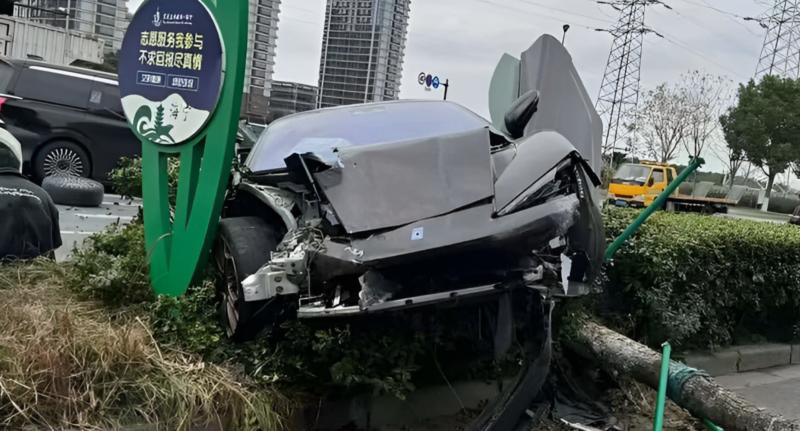
It was just another afternoon in Zhejiang province until the unmistakable sound of crunching metal echoed near Haitao Road. A Yangwang U9 supercar, one of only a few hundred delivered in China, plowed into the right rear of a stationary Zeekr 009 luxury MPV waiting at a red light. The impact sent the U9 careening into roadside greenery and an advertising structure before finally stopping.
Social media footage showed the aftermath: the Zeekr 009’s front end mangled with a wheel torn off, the Yangwang’s nose crushed, and a tiny BYD Seagull caught in the crossfire. Yet remarkably, all occupants walked away without serious injuries – a testament to how far Chinese EV safety has come.
Battery Safety: The Real Win
What had enthusiasts buzzing wasn’t just the crash survival, but what didn’t happen: no battery fires. Despite the U9’s high-speed impact and subsequent secondary collisions, its Blade Battery pack showed no signs of thermal runaway. This aligns with BYD’s notorious nail penetration test videos that went viral last year.
The Zeekr 009, packing CATL’s latest Qilin battery technology, similarly avoided any post-crash combustion – critical for an MPV designed to transport families. Even the budget BYD Seagull’s LFP cells held firm, proving that safety isn’t just for premium models anymore.
What This Means for Chinese EV Development
This accident provides real-world validation of China’s aggressive push into EV safety tech. Where early Chinese EVs earned skepticism, today’s models incorporate:
- Multi-directional crash protection in battery pack design
- Instant high-voltage cutoffs during impacts
- Reinforced passenger cages that outperform many ICE vehicles
The fact that all three vehicles – from a $100,000+ supercar to an economy hatchback – performed so well speaks volumes about China’s manufacturing parity with global brands. As new safety regulations take effect in 2026, we’re seeing the results of billions in R&D investment.
The Human Factor
Perhaps the most telling detail? Witnesses reported all drivers calmly using their phones roadside after the crash. While distracted driving is never advised, their relaxed demeanor suggests the crashes felt less violent than they looked – a credit to the vehicles’ crash energy management.
As Chinese automakers like Avatr and Zeekr expand globally, incidents like this demonstrate their safety credentials can compete with legacy brands. For consumers, it’s proof that today’s Chinese EVs offer more than just flashy tech and competitive pricing – they’re built to protect when it matters most.
Author: A longtime EV specialist with engineering background and firsthand experience testing Chinese vehicles from Shenzhen to Shanghai.