
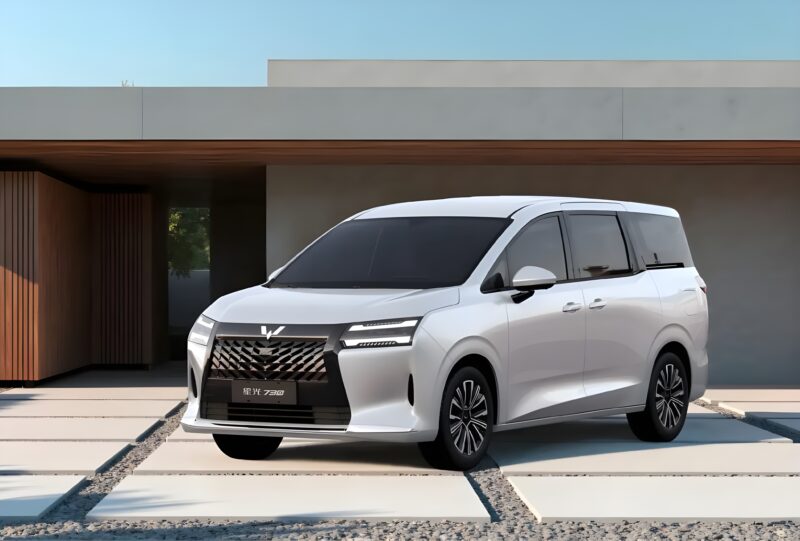
SGMW is rolling out its new Wuling Xingguang 730, a seven-seater MPV designed with families in mind. This isn’t just another minivan, though; it’s launching with three distinct powertrain options: a pure Battery Electric Vehicle (BEV), a traditional Internal Combustion Engine (ICE), and a Plug-in Hybrid Electric Vehicle (PHEV). This diverse lineup means there’s likely a Xingguang 730 for every kind of driver.
Powertrain Diversity and Design
Underneath the metal, the Xingguang 730 is built on some interesting tech. Early sightings of camouflaged prototypes hinted at SGMW’s “Lingxi Powertrain” and “Magic Battery” systems. These include an 800V high-voltage platform and advanced cell-to-body integration, which is a big deal for efficiency and packaging in Chinese EVs. A high-voltage platform generally means faster charging and better performance overall.
From an aesthetic standpoint, the variants have distinct personalities upfront. The BEV model sports a sleek, closed-off front fascia, which is typical for electric vehicles as they don’t need a large grille for cooling. Conversely, both the ICE and PHEV models feature a bold, polygonal V-shaped grille. All three share a unified rear design, complete with a high-mounted brake light and taillights that mirror the front lighting signature.
Practicality is key for an MPV, and the Xingguang 730 delivers with sliding doors a huge plus for tight parking spots or managing kids. It rides on 215/55R17 tires, and the blackened pillars give it a “floating roof” look, a popular design cue that adds a touch of modern flair.
Dimensions and Performance Details
This MPV is a substantial vehicle, measuring 4910 mm long, 1850 mm wide, and 1770 mm high, with a generous 2910 mm wheelbase. This size translates to a spacious interior, perfect for its seven-seater configuration.
Curious about how much these different versions weigh? Well, the BEV comes in at 1760 kg or 1810 kg, the ICE at 1610 kg, and the PHEV at 1818 kg. Those weight differences reflect the varying components of each powertrain.
Let’s talk power. The BEV variant gets a 100 kW (134 hp) electric motor, model TZ180XS2A0, paired with a lithium iron phosphate battery, giving it a top speed of 160 km/h. The ICE model packs a 1.5L LC4 engine that pumps out a respectable 130 kW (174 hp), pushing it to a top speed of 180 km/h. As for the PHEV, it combines a 1.5L LBG engine, delivering 78 kW (105 hp), with an electric motor, reaching a top speed of 170 km/h. Specifics on the PHEV’s all-electric range and its combined output still haven’t been revealed, but we’re certainly keeping an eye out for more details.
Wuling’s MPV Legacy
SGMW has quite a pedigree in the MPV segment, especially in China. Their lineup includes popular models like the Wuling Hongguang, Baojun 730, and Wuling Jiachen. Together, these models have racked up over 7.8 million unit sales, a testament to the brand’s understanding of what family buyers need. The Xingguang 730 looks set to continue that legacy, offering a modern, versatile option in a highly competitive market, much like other exciting new models continually redefine China’s auto market, embracing both traditional and electric powertrains.