
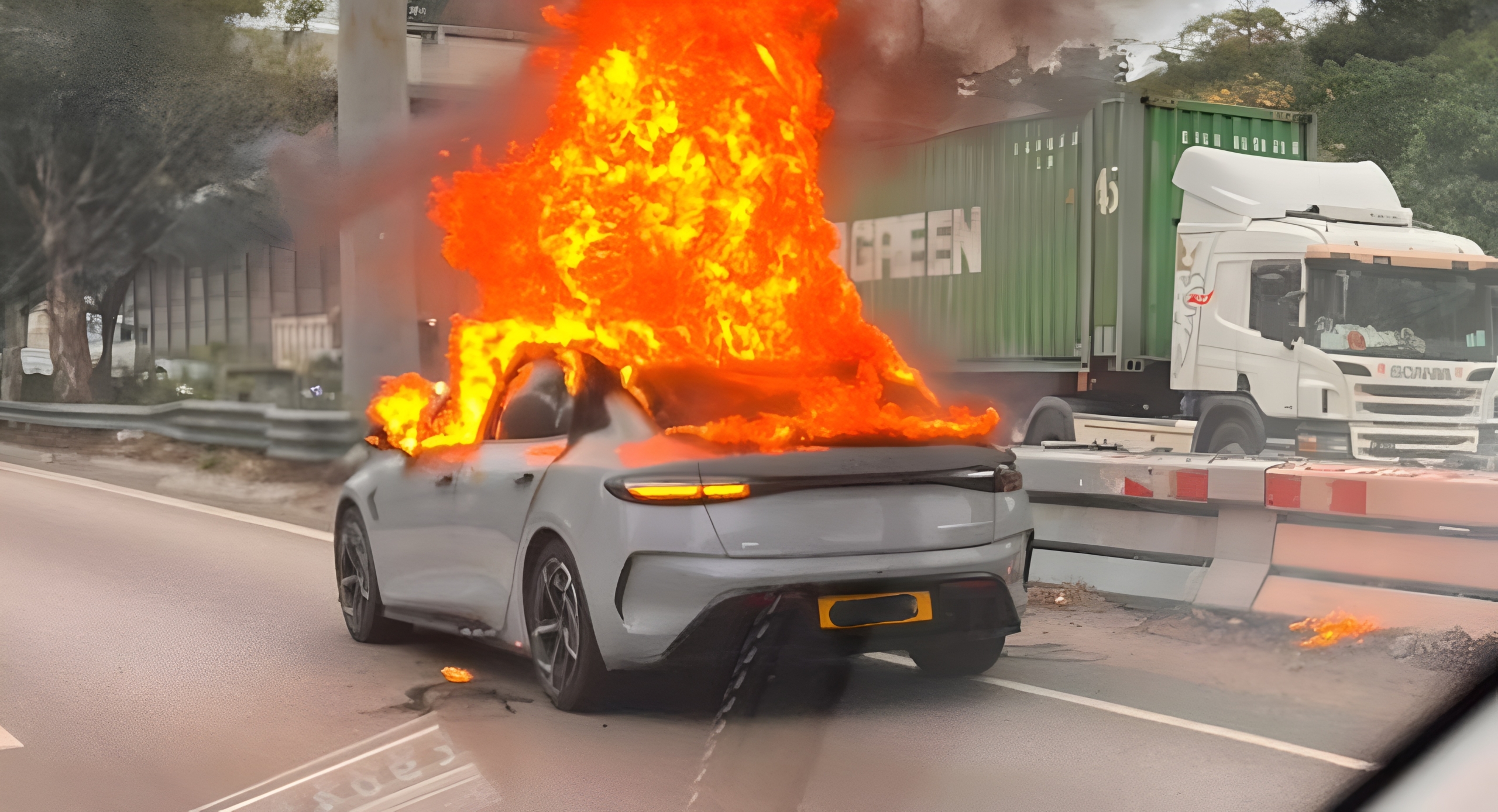
It was a stark image: a silver BYD Seal, a sleek electric sedan, engulfed in flames on Hong Kong’s Tuen Mun Road. The incident, on March 3, 2026, near the Tsing Tin Interchange, brought traffic to a standstill. Thankfully, the driver escaped unharmed before the fire escalated, and emergency services were quick to extinguish the blaze within 18 minutes. While dramatic, the aftermath revealed a lot about modern EV safety, particularly the resilience of BYD’s engineering.
What could have been a PR nightmare turned into a testament to BYD’s design. A thorough investigation at a BYD service center pinpointed the cause: not a fault with the car’s sophisticated electric systems, but an external power bank left on the passenger seat. This portable charger, likely experiencing a short circuit, was the ignition point. BYD was quick to reassure the public, confirming that the vehicle’s high-voltage systems and, crucially, its renowned “Blade Battery” were never compromised. This is a critical distinction. The battery pack and its integrated chassis remained intact, even as the cabin suffered extreme heat, melting plastics and glass.
This incident highlights a key advantage of BYD’s LFP (Lithium Iron Phosphate) battery chemistry. Unlike traditional NMC (Nickel Manganese Cobalt) batteries, which have a lower thermal runaway threshold, LFP batteries can withstand much higher temperatures, typically over 500°C. The Seal’s battery pack is also a structural component of the car’s chassis, thanks to its Cell-to-Body (CTB) technology. This design, part of the e-Platform 3.0, not only boosts rigidity to an impressive 40,500 Nm/° (rivaling luxury performance cars) but also creates a formidable protective barrier. The “sandwich” construction, with strong aluminum panels, effectively insulated the battery cells from the cabin fire.
Beyond safety, the BYD Seal offers a compelling package for daily driving. Its robust chassis contributes to a refined ride, and features like the center airbag and automatic eCall system underscore a commitment to occupant protection. In the competitive Hong Kong market, the Seal is a strong contender, estimated to deliver around 4,200 units in 2025, closely followed by the Tesla Model 3 (estimated 5,800 units). Both boast 5-star Euro NCAP safety ratings, but BYD’s focus on the thermal stability of its LFP Blade Battery sets it apart. As of early 2026, the Seal also holds a price advantage, starting at approximately $30,000 USD after local incentives, compared to the Model 3’s roughly $34,500 USD starting price.
The Chinese EV market is evolving at breakneck speed. Manufacturers like BYD are not just competing on price and features but are pushing boundaries in battery technology and structural integration. This relentless innovation, driven by intense domestic competition and supportive government policies, means products are updated frequently, often incorporating advancements faster than global counterparts. While incidents like the one on Tuen Mun Road are concerning, the investigation into the BYD Seal fire ultimately showcased the impressive safety engineering inherent in these modern electric vehicles, especially the advanced battery protection systems that are becoming a hallmark of leading Chinese EV makers. It’s a reminder that understanding the technology, like the LFP chemistry and CTB integration, is key to appreciating the real-world safety and performance these cars offer.