
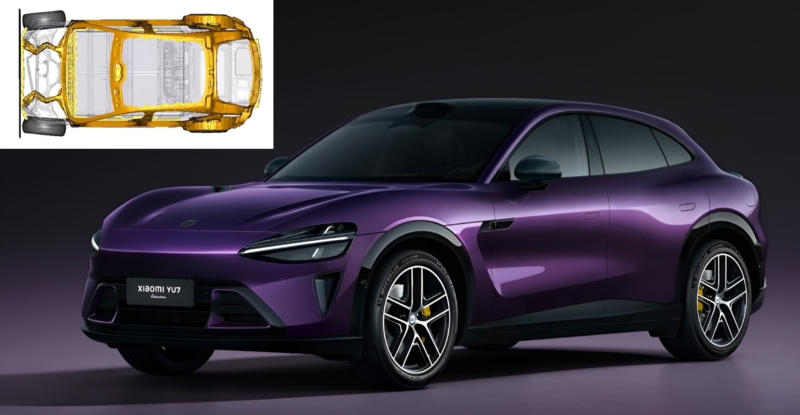
Xiaomi’s YU7 electric SUV just earned some serious bragging rights. It took home the “Best Structure” award, the top prize at the 2025 International Die Casting Competition, for a brilliantly engineered component that’s shaking up how cars are built. This isn’t just a trophy. it’s a sign that Xiaomi is playing for keeps in the competitive world of electric vehicles.
The award celebrates the YU7’s 20-in-1 integrated die-cast aluminum triangular beam. That sounds complex, but the idea behind it is simple and elegant. Instead of assembling dozens of separate parts for the front of the car, Xiaomi created a single, complex module. It’s a move that speaks volumes about their manufacturing prowess, especially for a company relatively new to the auto industry.
So, What Does This Super-Beam Actually Do?
This single component is a triple threat. First, it’s a critical part of the car’s safety cage, designed to manage and distribute forces from a frontal collision to protect everyone inside. Second, it acts as a mounting point for the entire thermal management system, including the air conditioning, compressor, and cooling hardware.
By integrating all these systems into one structure, Xiaomi’s engineers freed up an incredible amount of space. The result is a surprisingly large 141-liter front-storage compartment, or “frunk,” a practical benefit any owner will appreciate. It demonstrates how smart engineering can directly improve a car’s daily usability. It’s a design choice that adds a layer of practicality often missing in performance-focused SUVs, similar to the packaging debates seen in the design of the Xiaomi YU7.
A Stiff Chassis and a Stable Ride
The innovation doesn’t stop there. This die-cast beam works with the cell-to-body (CTB) battery architecture, where the battery itself is a structural part of the floor. Together, they give the YU7 a torsional rigidity of 47,610 N·m/deg. For the driver, this high stiffness translates into a car that feels solid, responsive, and stable, especially during cornering or on uneven roads. It’s the kind of solid foundation you feel on every drive.
Xiaomi’s Rising Tide in the EV Market
The award, presented by the prestigious North American Die Casting Association (NADCA), validates Xiaomi’s approach on an international stage. This recognition comes as Xiaomi’s growing automotive production is making waves in China. In October 2025, the company’s retail sales of new-energy vehicles hit 48,654 units. Wholesale shipments of the YU7 alone reached 33,662 units, impressively surpassing the sales of the Tesla Model Y in China for the same period. This sales performance shows that Xiaomi is not just an innovator but also a major competitor, challenging established players like Tesla.
While other carmakers use large-scale die casting, Xiaomi’s 20-in-1 integration sets a new benchmark for efficiency. The company is staying quiet about production costs and yields, but it has confirmed its commitment to investing heavily in structural engineering. This focus on fundamentals suggests that the YU7 is just the beginning, and with recent patents filed, it hints at a push into non-pure-EV vehicles, showing the breath of their ambition.