
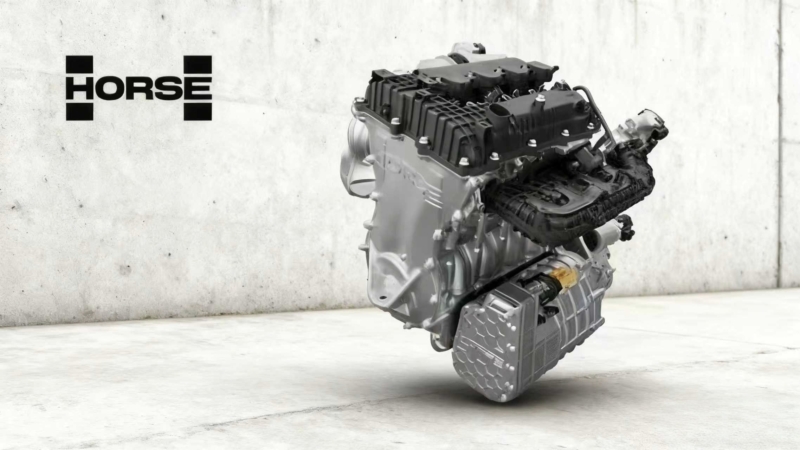
Horse Powertrain, the joint venture between GeelyHolding and Renault Group, is shaking things up in the EV world. They have revealed a “Future Hybrid System” set to hit the market in 2027. This innovative tech aims to transform existing electric-only platforms into flexible hybrid or range-extended vehicles.\n\nFirst teased as a concept at the Shanghai Auto Show in early 2025, and later refined for the IAA in Munich the same year, this hybrid system is part of Horse Powertrain\’s X-Range family. It is a bold move to offer a wider array of choices for consumers as the automotive landscape continues its rapid evolution.\n\n
Compact Design, Big Impact
\n\nWhat makes this system stand out is its incredibly compact architecture, integrating the internal combustion engine, gearbox, electric motor, and electronic power systems into a single, tight package. Imagine fitting all that tech into a space typically reserved for just the electric power unit!\n\nHorse Powertrain is offering two variants. There is a performance-oriented P1+P3 dual-electric motor setup, measuring 740 millimeters wide. For those looking for something even more streamlined, a super-compact P2 motor variant comes in at just 650 millimeters. Both options seamlessly pair with a 1.5-liter four-cylinder engine and a dedicated hybrid gearbox.\n\nThe real genius here lies in its design. This compact layout shaves off about 150 millimeters from the front overhang compared to traditional hybrid systems. That means automakers can essentially drop this powertrain onto the subframe of an existing battery-electric vehicle with minimal fuss. Think fewer modifications to the body structure and a smoother production process. It is an ingenious solution for rapidly expanding hybrid offerings without reinventing the wheel.\n\n
Versatility and Environmental Consciousness
\n\nThis hybrid system is a true chameleon, supporting multiple drivetrain configurations. Whether you are after a plug-in hybrid (PHEV) or a range-extended electric vehicle (EREV), Horse Powertrain has you covered. Even better, it offers both front-wheel drive and all-wheel drive options, making it suitable for everything from compact city cars to more adventurous vehicles.\n\nHorse Powertrain’s meticulous design also keeps pure-electric platform components in mind. Things like HVAC and PFAS-free air-conditioning systems are preserved, allowing for the reuse of many existing EV parts. That is a smart play for both cost-effectiveness and reducing environmental impact.\n\n
Fueling the Future
\n\nAnother brilliant aspect of this system is its impressive fuel compatibility. It can run on gasoline, E85 ethanol, M100 methanol, and even synthetic fuels. This wide-ranging capability aligns perfectly with the global push towards low-carbon, flexible-fuel powertrains. It is about giving consumers and manufacturers more options as energy sources continue to diversify.\n\nHorse Powertrain isn\’t stopping there. They are actively developing a three-cylinder variant that promises to shrink the system\’s width by another 70 millimeters. This would make it an even more attractive option for smaller vehicles where every millimetre counts.\n\n
A Global Force with a Vision
\n\nFormed in mid-2023, Horse Powertrain is a serious player on the global stage. With 17 production plants, five research and development centers, and roughly 19,000 employees, they have the muscle to make a significant impact. This new hybrid system is their ticket for automakers to swiftly convert electric vehicle platforms into hybrid or range-extended variants without extensive reengineering. It is also an easier pathway for consumers into the electrified world. For example, some Chinese manufacturers are already excelling at making diverse power options. Check out how \Xpeng\’s G6 EREV offers extended range, or how \Lotus is diving into PHEV SUVs.\n\nIndustry insiders view this as a strategic move to cater to varied market preferences and the diverse fuel infrastructures across different regions. It is a testament to how Chinese automakers and their partners are pushing boundaries, as seen with companies like \BYD surging past production milestones and how others are embracing advanced technologies like those seen in the \Dongfeng hybrid engine. This adaptability could be a game-changer for the mass adoption of electrified vehicles worldwide, blending the best of both electric and combustion worlds.