
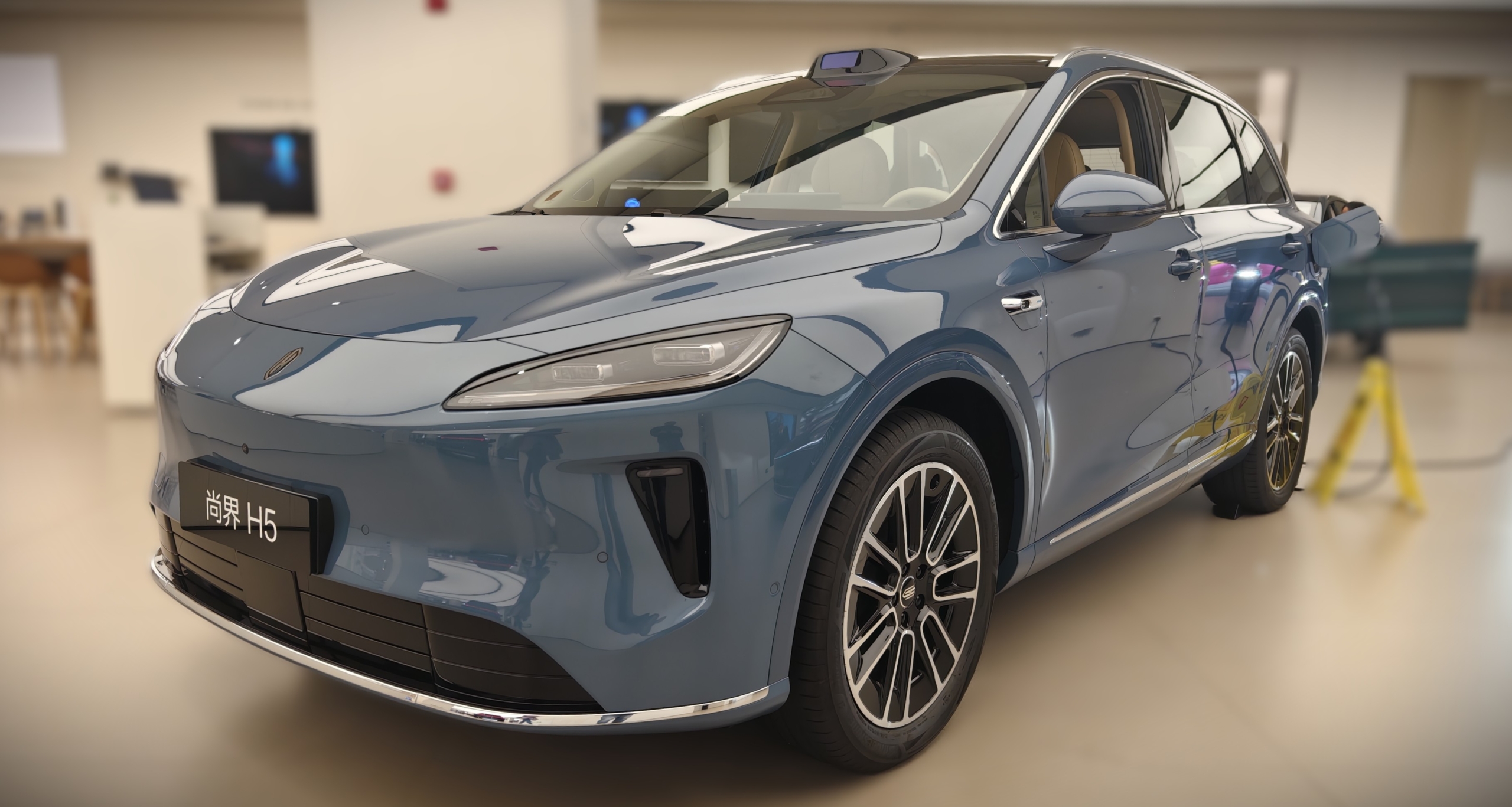
The Saic H5 has arrived, and it’s more than just another SUV. It’s the most accessible entry point into the Harmony Intelligent Mobility Alliance (HIMA), a fascinating collaboration between tech giant Huawei and automotive stalwart SAIC. Starting at a very competitive 159,800 yuan (around $22,000 USD), the H5 leverages SAIC’s established manufacturing prowess and pairs it with Huawei’s cutting-edge intelligent driving and cockpit systems. This isn’t just about making a car; it’s a strategic move to bring advanced autonomous driving hardware to the mainstream mid-size SUV segment, directly challenging rivals like the Leapmotor C11.
We tested the Max EREV trim, which comes in at 179,800 yuan (about $24,800 USD). This model is equipped with the impressive Huawei ADS 4.0 system, showcasing HIMA’s shift towards capturing high-volume, younger demographics. By moving away from the premium pricing of its Aito and Stelato siblings, the H5 is a crucial test for Huawei’s technical brand appeal. Can it win over buyers in price-sensitive segments where margins are tightest?
A Practical Design with a Purpose
Don’t let the tech fool you; the H5 is a thoughtfully designed mid-size crossover. It measures 4,780 mm long, 1,910 mm wide, and 1,664 mm tall, with a wheelbase of 2,840 mm. What’s notable is its restraint. Instead of chasing massive dimensions, the H5 maintains a compact feel, making it a breeze to maneuver in crowded city streets and a dream to park. This practical approach appeals to drivers who value agility as much as space.
Up front, you’ll find integrated lighting and an active air intake system to keep the range extender’s engine happy. The side profile offers a slight departure from typical HIMA trends with conventional door handles, a nod to upcoming Chinese standards for emergency access and mechanical reliability. Dominating the roofline is a 192-line lidar unit, the primary sensor for the advanced autonomous driving suite, hinting at the powerful tech packed within.
The rear features a clean, single-piece taillight and a steeply raked tailgate. Underneath, the platform is borrowed from the SAIC Roewe ES39, influencing the suspension layout and overall stance. Aerodynamics are a key focus, with a flat underbody and specially designed wheel arch liners to cut through the air. The EREV version tips the scales at 2,000 kg, while the all-electric variants are slightly lighter, thanks to clever chassis design.
HarmonyOS Cockpit and Comfortable Cabin
Step inside, and you’re greeted by a 15.6-inch floating touchscreen running Huawei’s HarmonyOS cockpit system. What’s different here is the layout: the main screen is dedicated to navigation, while the impressive surround-view visualization (SR) is smartly placed on the driver’s instrument cluster. Below the screen, you’ll find not one, but two 50W wireless charging pads, and a cavernous storage area in the center console perfect for stashing larger items.
The cabin materials are layered and pleasing. Soft-touch plastics grace the upper dashboard and door panels, complemented by a mix of synthetic leather and faux suede. Even the headliner uses a woven fabric, a thoughtful touch at this price point. Physical buttons are scarce, with most functions, from climate control to mirror adjustments, seamlessly integrated into the touchscreen or the D-shaped steering wheel.
Build quality is a strong suit. You’ll find soft-touch materials covering nearly every visible surface, and the door panels boast a satisfying quad-layer construction. The only exceptions are the B and C pillars, which are hard plastic, but this is a minor quibble in an otherwise premium-feeling interior. Even the conventional door handles have a solid, spring-loaded action that speaks to good engineering.
Rear passengers will appreciate the flat floor, a benefit of the electric architecture, and the two-stage reclining rear seats (27 and 32 degrees). The 2,840 mm wheelbase translates to generous legroom, rivaling larger SUVs. And when it’s time to pack up, the 601-liter trunk can swallow up to six 20-inch suitcases standing upright.
Performance and Handling: A Surprising Drive
The Saic H5 Max EREV is powered by a 1.5-liter, 72 kW (97 hp) four-cylinder range extender. Its sole job is to act as a generator, keeping the 32.6 kWh lithium-iron phosphate (LFP) battery topped up. The actual propulsion comes from a rear-mounted permanent magnet synchronous motor delivering 150 kW (201 hp) and 280 Nm of torque. This setup offers a CLTC pure-electric range of 235 km, with a combined range extending to an impressive 1,360 km.
Underneath, you’ll find MacPherson struts up front and a multi-link independent setup at the rear. Unlike more premium HIMA models, the H5 sticks to a purely mechanical suspension, foregoing air springs or adaptive damping. However, the tuning is where it shines. SAIC’s engineers have collaborated to create a chassis that prioritizes stability and controlled damping. During spirited driving, body roll is well-managed, and the car exhibits a surprising amount of mechanical grip. It feels more European in its calibration than the softer approach seen in some rivals, like the Aito M7.
The steering is quick and precise, with minimal dead zone around the center. The electronic power steering offers a linear build-up of weight, especially in sport mode. Braking is handled by a sophisticated drive-by-wire system that seamlessly blends regenerative and friction braking, providing a consistent pedal feel. While NVH levels are generally excellent, thanks to acoustic glass and good insulation, the range extender can become noticeable when it kicks in under heavy load.
Huawei ADS 4.0: A Glimpse of the Future
The Huawei ADS 4.0 system in the Max trim is a real standout. It combines a 192-line lidar, three 4D millimeter-wave radars, and eleven cameras. In urban driving, it showcases impressive end-to-end neural network capabilities, navigating complex construction zones and even spotting unexpected obstacles like small toolboxes on the road. The system maintains a safe following distance and exhibits human-like decision-making when dealing with delivery vehicles or pedestrians.
The Verdict: Value Meets Intelligence
The Saic H5 is a compelling package. It aims to democratize advanced autonomous driving hardware by offering the Huawei ADS 4.0 system and the integrated HarmonyOS ecosystem in a SAIC-developed chassis at a significantly lower price point than many competitors. While it may not have the air suspension or brand prestige of some larger HIMA models, its agile handling and smart technology make it a standout in the mid-size SUV segment. It directly challenges vehicles like the Leapmotor C11 and even takes on the Tesla Model Y by offering more advanced lidar and software at a more accessible price. With its practical dimensions and family-friendly interior, the H5 is poised to be a smart choice for many buyers.
By Adrian Leung
Writer
Adrian, an Electrical and Computer Engineering graduate with a love for cars, brings expertise and enthusiasm to every test. He also enjoys audio, photography, and staying active.