
Chery has officially announced a strategic partnership with Japanese automotive aftermarket giant Autobacs Seven and other partners to launch a new electric vehicle brand, EMTA. The brand is specifically designed to target the Japanese Kei car (K-Car) market, with the first all-electric model scheduled for release in the spring of 2027. The company aims to introduce a total of four models by 2029.
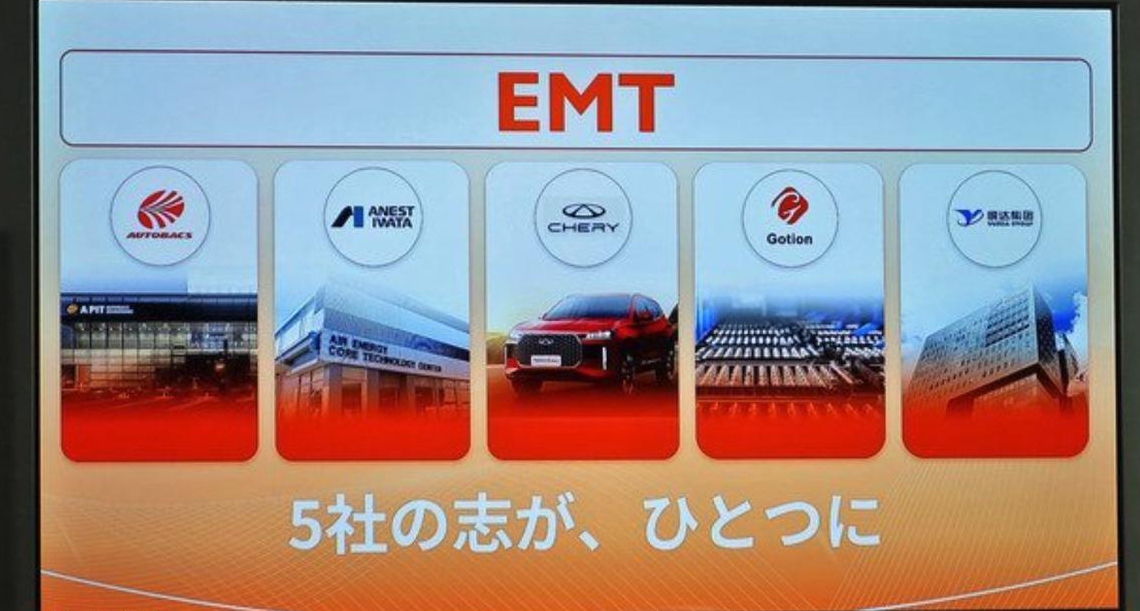
The operational entity behind EMTA is the Japanese firm EMT Co., Ltd., which is a subsidiary of EMT (Electric Mobility Technologies), a joint venture established in Singapore in August 2025. The ownership structure is highly collaborative, with Chery and Jiangsu Yueda Auto Group serving as the joint-largest shareholders, each holding a 27.27% stake. Other partners include Autobacs Seven and Gotion High-Tech, each with 18.18%, and Anest Iwata, holding 9.09%.
The project leverages the specific strengths of each partner: Chery provides the vehicle platform, electric powertrain, and intelligent driving technologies; Yueda’s Yancheng plant handles manufacturing; Gotion High-Tech supplies the batteries; Autobacs Seven manages distribution, sales, and local operations; and Anest Iwata provides painting processes and quality support. Chery has clarified that it acts as a shareholder and is not involved in the daily management of EMT.
EMTA positions itself as a “Japanese-originated” EV brand, focusing on the K-Car segment. While the product concepts and design decisions are led by a Japanese team—which includes former engineers from Honda and Mazda—the brand emphasizes a fusion of Chinese technology and Japanese market requirements. The leadership team includes former Nissan China General Manager Susumu Uchi-koshi as CMO and former Changan Ford President and Chery Vice President He Xiaoqing as CEO.
The business model involves initial production in China for the Japanese market, with plans to localize manufacturing in Japan after 2030. Sales will be supported by Autobacs Seven’s extensive network of approximately 1,200 retail stores across Japan, with plans to establish 100 dedicated sales and service points by the 2027 launch.
This move represents a unique “light-asset” localization strategy for Chinese automakers, navigating the Japanese K-Car market—a segment currently seeing low EV penetration but high potential—while facing direct competition from rivals like BYD.