
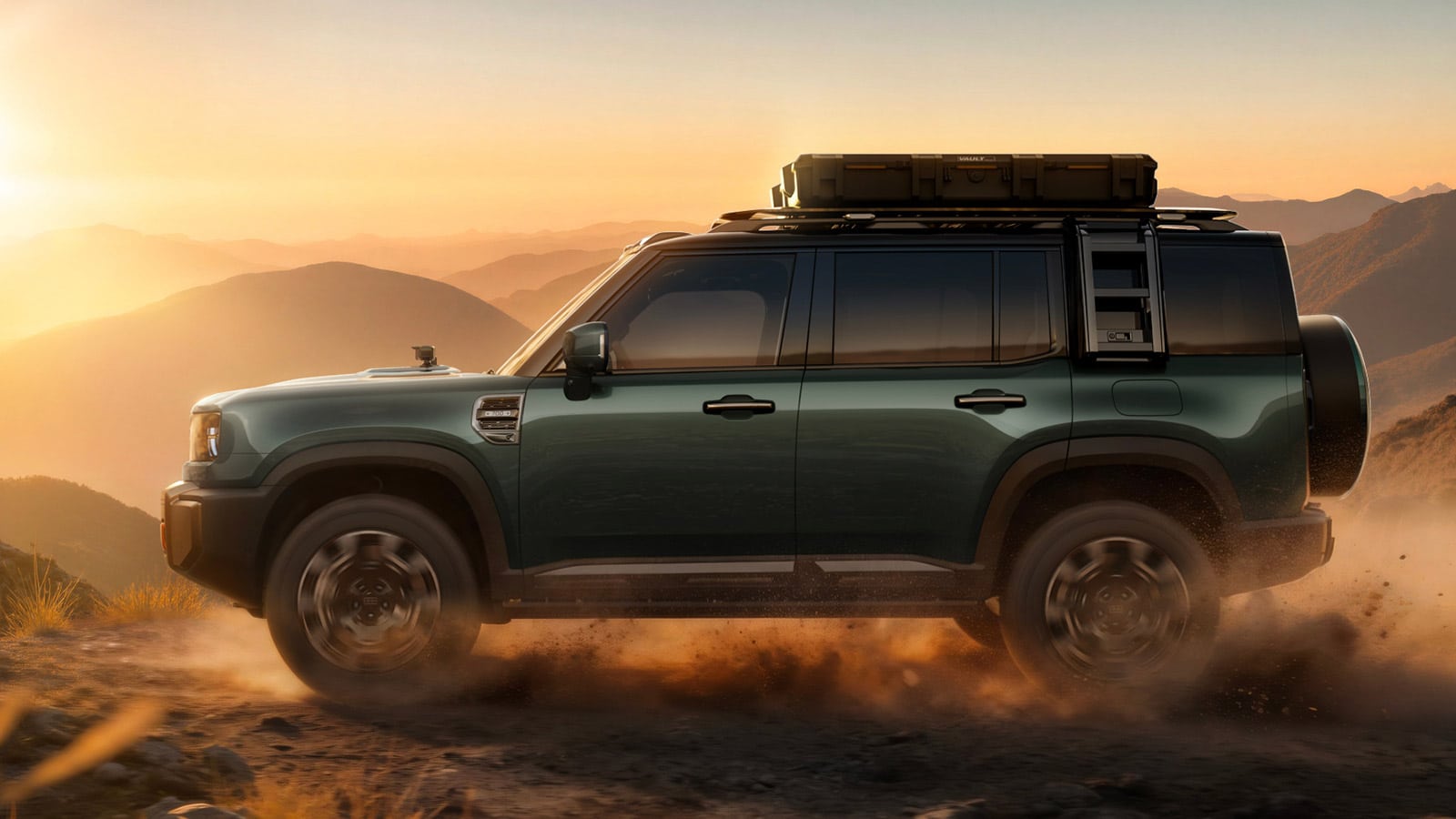
If Geely Galaxy wanted a quiet entry into the hardcore SUV fight, the Cruiser 700 is the wrong machine. This thing arrives with 1,113 hp, a boxy body, a roof LiDAR pod, and a spare wheel hanging off the back like it means business.
The Geely Galaxy Cruiser 700, also called the Zhanjian 700, made its official debut on Friday and is due to go on sale later this year. After that, Geely plans to take it to Milan on July 26 for an overseas appearance.
Geely Galaxy Cruiser 700 design and cabin
Geely has gone for the familiar off-road playbook here. The Cruiser 700 gets a boxy profile, a full-width daytime running light, and an illuminated Galaxy badge in the center. Around the back, there are vertical rounded-rectangle taillights, a side-hinged tailgate, and an externally mounted spare tire. Nothing about it tries to look soft.
The cabin follows the same idea. There’s a large floating center screen, a full-width digital instrument panel, and still enough physical controls to make sense when you’re bouncing around off pavement. You also get an aircraft-throttle-style gear selector, a rotary drive-mode dial, and a five-seat layout. Geely says there’s a concealed roll cage, an 18.5-liter onboard refrigerator, and more than 100 factory-developed off-road accessories.
| Metric | Value | Notes |
|---|---|---|
| Length | 5,085 mm | Large SUV footprint |
| Width | 1,999 mm | Nearly 2 meters wide |
| Height | 1,895 mm, 1,912 mm, 1,925 mm | Depends on version |
| Wheelbase | 2,900 mm | Long enough for a roomy cabin |
| System output | 830 kW, 1,113 hp, 1,128 Ps | Tri-motor PHEV setup |
| Battery | 47.14-kWh LFP | Supplied by CATL |
| Electric range | 165 km to 185 km | CLTC-style number, real-world use will be lower |
| Wading depth | 800 mm | Serious water-crossing capability |
Geely Galaxy Cruiser 700 powertrain and off-road tech
Under the skin, this is where the Cruiser 700 gets attention. It uses a tri-motor, four-wheel-drive plug-in hybrid system with differential locks. Combined output is 830 kW, or 1,113 hp. That’s supercar territory in a five-seat off-roader, and it explains why Geely is talking so much about desert slopes and sustained climbing.
The power-to-weight ratio is 392 Ps per ton. That figure matters more than the headline horsepower number, because it tells you the Cruiser 700 should feel strong even when the pace gets slow and the ground gets ugly. Geely says it has the highest power-to-weight ratio of any mass-produced off-road vehicle worldwide, and the highest combined system output among mass-produced plug-in hybrid off-road vehicles.
The battery pack is a 47.14-kWh LFP unit from CATL, with an electric-only range of 165 km to 185 km. In day-to-day use, that should cover short city runs and trail access without burning fuel the whole time, though buyers should expect real-world range to sit below the official figure once the weather turns cold or the road gets messy.
The Cruiser 700 also uses Geely’s in-house GVMC system. Geely says it can pass the moose test at 80 km/h. On top of that, the AI four-wheel-drive system can switch between front-wheel drive, rear-wheel drive and four-wheel drive on its own. It also gets crab-walk mode, tank turns, continued driving after a tire blowout, automatic obstacle avoidance, satellite communications, and an 800 mm wading depth.
If you want a second take on the same model, our Geely Galaxy Cruiser 700 plug-in hybrid details article goes deeper on the hybrid setup and positioning.
What this means for Chinese SUV buyers
The timing makes sense. Chinese brands are piling into the rugged SUV segment, and the field already includes names like BYD and GWM. Those companies have been moving fast, so Geely can’t afford to treat this as a vanity project. It needs a vehicle that looks the part and has enough real hardware to back it up.
That’s the bigger story here. Geely Galaxy has been one of Geely’s brighter sub-brands, but the pace has cooled this year. The Cruiser 700 looks like a shot at getting some heat back into the showroom traffic.
The numbers help. Geely Galaxy sold 108,206 vehicles in June, up 19.93% year on year and 32.40% from May. That ended five straight months of year-on-year declines. For the first half of the year, the brand sold 519,793 vehicles, down 5.22% year on year.
For buyers, the question is simple: does this make sense as a real off-road buy, or is it just another flashy spec sheet? If you want a large PHEV SUV with serious output, a deep equipment list, and the flexibility to run electric for shorter trips, it looks promising. If you want proven resale, a long local service record, and no questions about long-term support outside China, you may want to wait and watch how Geely prices it and how quickly it reaches export markets.
Geely has built something attention-grabbing here. The harder part comes next. It has to sell it at a price that makes people choose a Chinese rugged SUV over the better-known names in the segment.
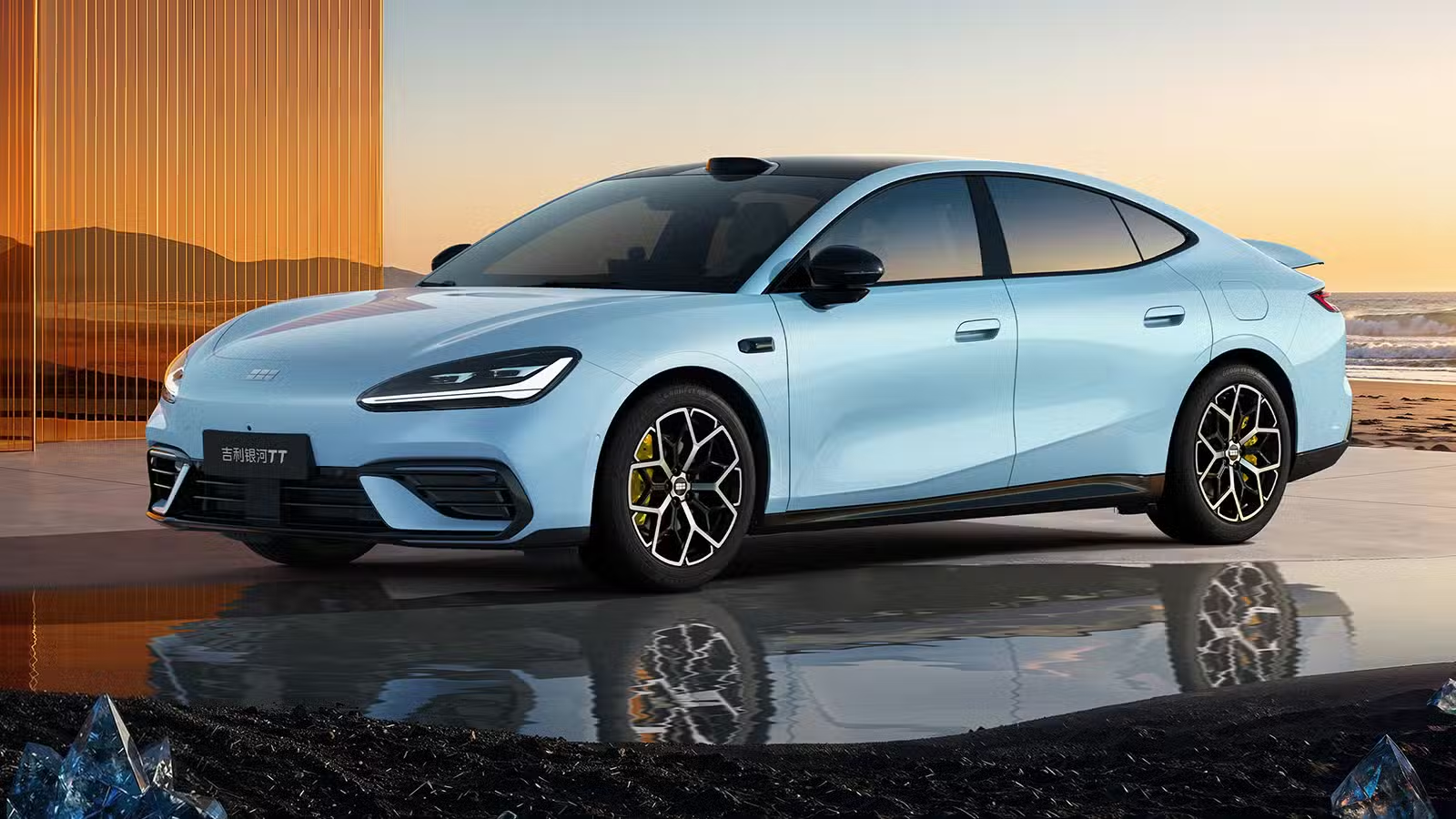
For readers tracking Geely’s broader overseas push, Geely Galaxy models set for Pakistan is worth a look. And if you’re watching how Chinese brands are chasing younger buyers with more style-led products, the Geely Galaxy TT story gives useful context.