
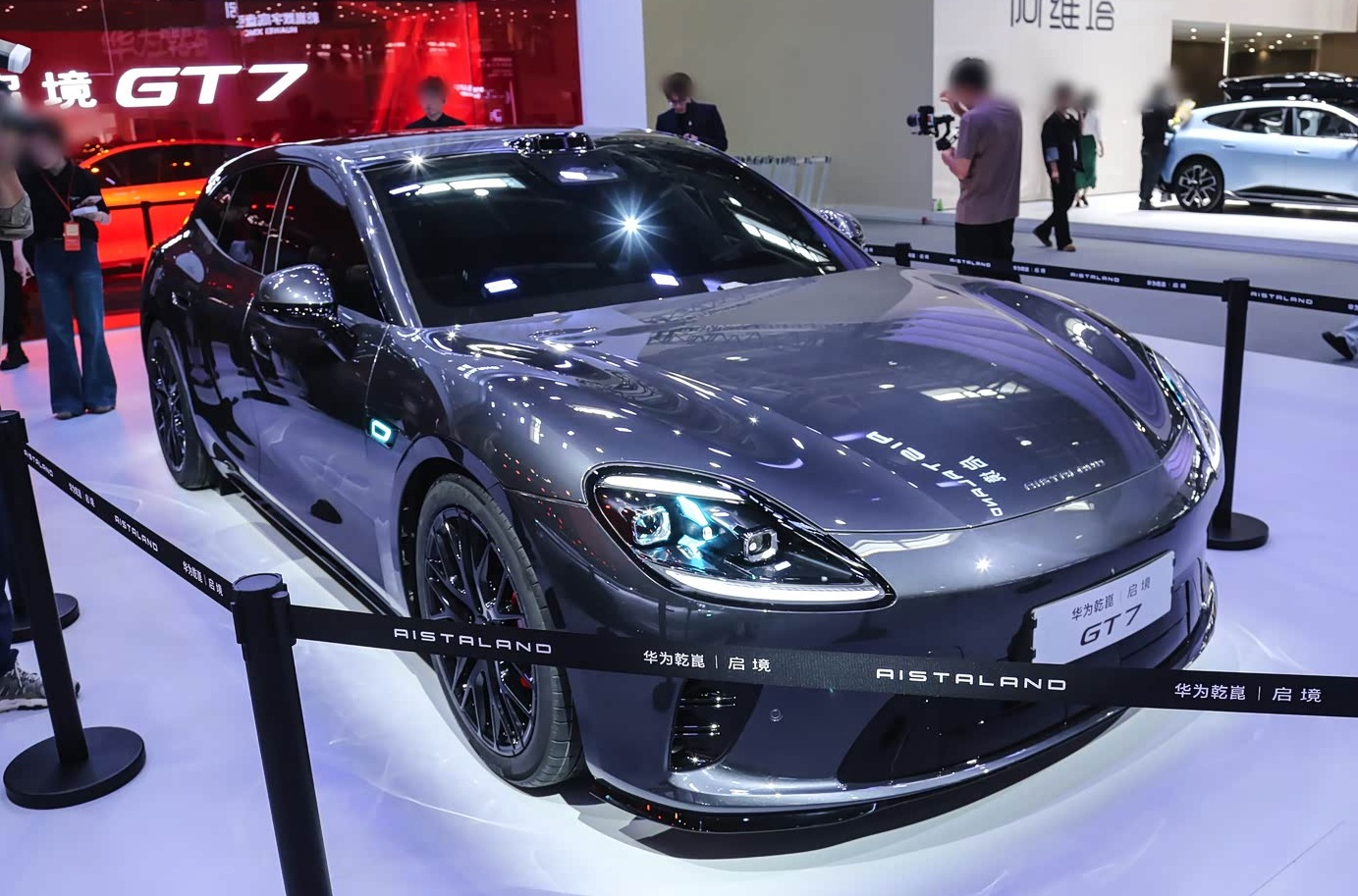
At the 2026 Beijing Auto Show, the Aistaland GT7 made its official debut. As the first model under the “Jing” series—a collaborative effort between GAC and Huawei—the vehicle is positioned to compete directly with the SAIC-Huawei joint venture model, the Stelato Z7T. While Huawei acts as the technology supplier, this rivalry highlights a direct confrontation between two major state-owned automotive giants, GAC and SAIC.
In terms of design, the front fascia of the GT7 can be viewed as an alternative interpretation of the Stelato Z7T’s aesthetic, leaning into a classic look but with a more rounded, streamlined profile. Key design elements include slim, flat headlights, a prominent nose, a trapezoidal lower grille, and functional air intakes in the fog light area. As expected for a Huawei-powered vehicle, a roof-mounted LiDAR sensor is standard.
The side profile showcases a classic shooting brake silhouette, characterized by a gently sloping roofline, a steeply raked D-pillar, flush door handles, large-diameter wheels, and frameless doors. The blacked-out trim and red brake calipers emphasize its sporty intentions, while the warm-toned paint options give it a more vibrant personality.
The rear design features a distinctive lighting signature: a thick, full-width light bar with a scattering light effect above it, and hollowed-out, bent extensions on both sides that enhance the sporty aesthetic. While these elements appear largely decorative, they contribute to a cohesive design language. A roof spoiler and a spacious trunk lid suggest a focus on practicality, while the multi-layered rear bumper completes the look.
Although the interior was not revealed at the show, suggesting that its development timeline may be slightly behind the Z7T, this could potentially allow GAC to adjust its pricing strategy to gain a competitive edge. Regarding performance, the announced models are equipped with a rear-mounted single motor producing 340 horsepower. The vehicle is built on an 800V high-voltage architecture, supporting 6C ultra-fast charging, and features a dual-chamber air suspension system to ensure a refined driving experience. Further details are expected to be released by the manufacturer soon.
Your daily pit stop for Chinese EV news, tech, and trends.