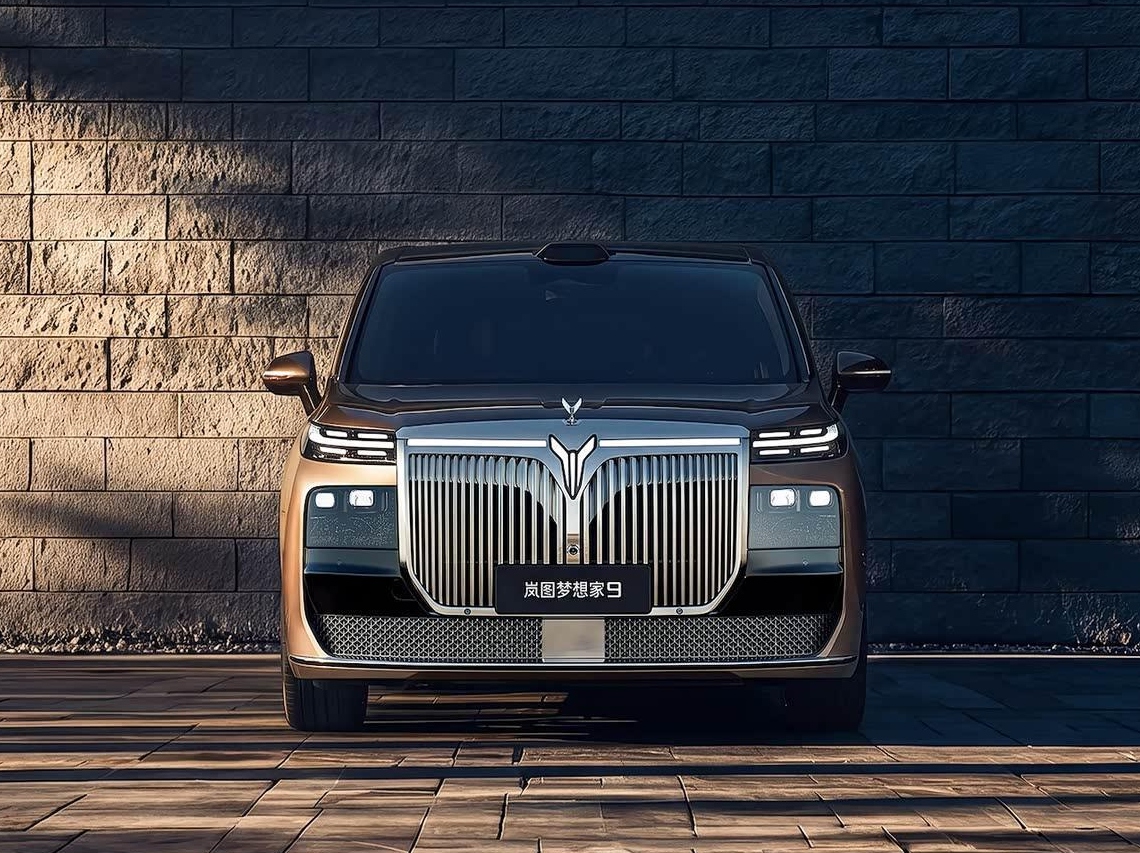

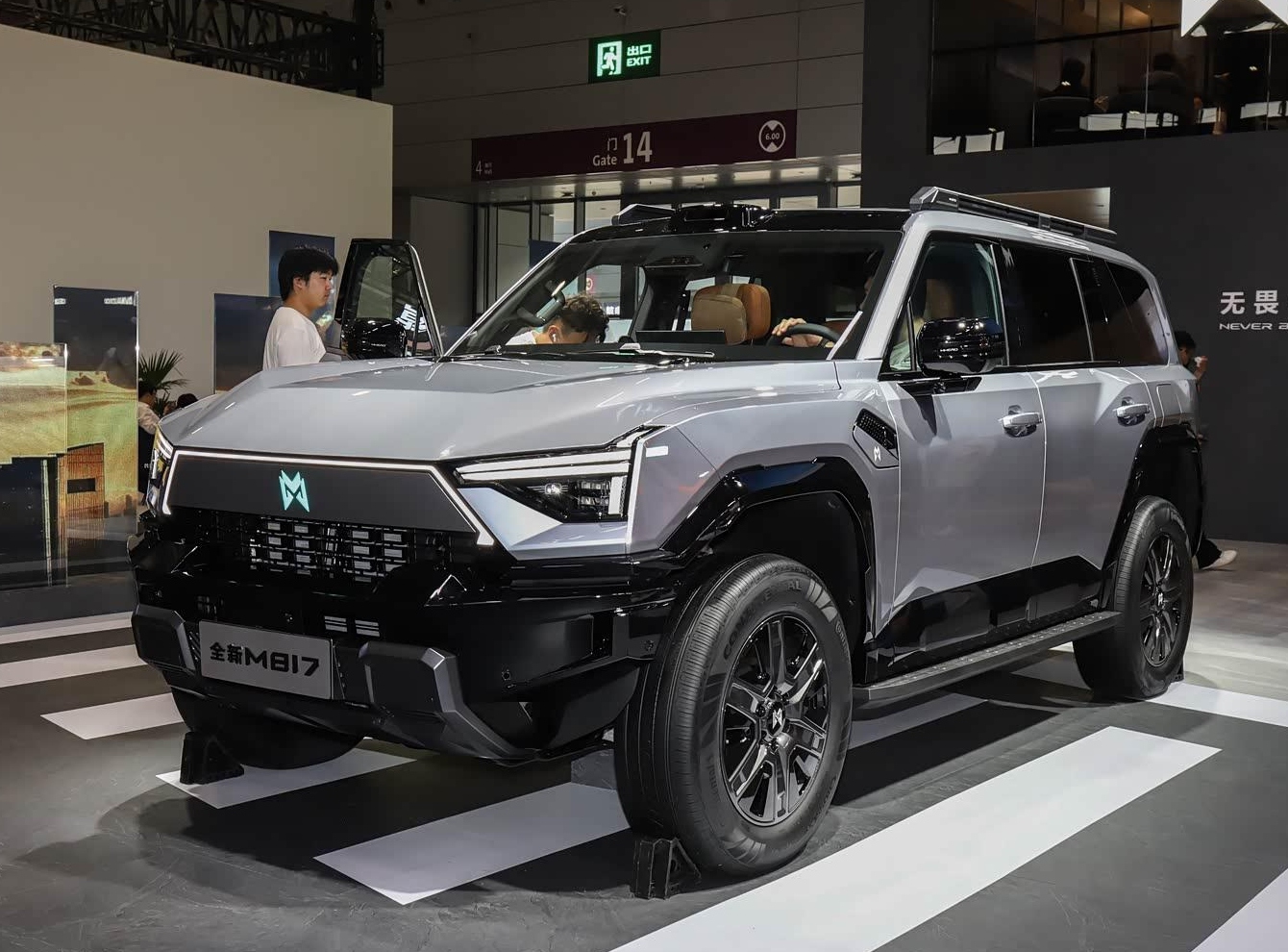
Dongfeng’s Mengshi M817 is now in customer hands, and the numbers are wild even by China’s current SUV arms race: up to 715 kW, 1,241 N·m, a 9.6 minute 30% to 80% charge, and a 900 mm wading depth. This isn’t a soft city SUV wearing hiking boots. It’s Dongfeng trying to make a luxury off-roader feel half military truck, half Huawei tech demo.
The M817 has officially started deliveries in China after launching in five trims. Pricing runs from 299,900 to 399,900 RMB, which works out to about $41,300 to $55,000 USD. That puts it in an awkward but interesting space: far cheaper than a Mercedes G-Class, more expensive than many domestic plug-in hybrid SUVs, and aimed at buyers who want road presence first and rational accounting second.
Mengshi M817 price and size: big SUV, big attitude
Dongfeng hasn’t toned down the styling. The M817 keeps the brand’s “Hero Soul Aesthetics 2.0” design language, including the cross-shaped “Sword Pointing to the Sky” taillights at the rear. It’s a bit theatrical, sure, but Chinese buyers in this part of the market often want that. Subtle doesn’t sell many hardcore-looking SUVs.
The body measures 5,100 mm long, 1,998 mm wide, and 1,899 mm tall, with a 3,005 mm wheelbase. In plain English, it’s a large three-row-sized footprint even if the focus here is more outdoor kit than school-run practicality. The external rear storage box adds some trail credibility, though owners should check how it affects parking camera views and garage clearance in daily use.
Six exterior colors are offered: Ulan Orange, Gezong Black, Yulong Silver, Mingsha Yellow, Qinling Green, and Kunlun White. The orange and yellow shades will get attention. The black one will probably look meanest outside a hotel in Chengdu.
Huawei cockpit tech gives the Mengshi M817 its China-market edge
The cabin goes for a flat, tough-looking dashboard, a dual-spoke multi-function steering wheel, and a large floating central touchscreen. Interior color choices include Xia Ying Orange, Ying Song Black, Danxia Brown, and Jinchuan Red. This is where the M817 starts to feel very Chinese in the best sense: the hardware is only half the pitch. The software stack matters just as much.
Dongfeng fits HarmonyOS Cockpit Off-Road Edition, based on HarmonyOS 6.0, with an intelligent off-road agent for route planning. Huawei’s role goes deeper through Qiankun ADS 5.0, using an 896-line dual-optical path LiDAR. The headline feature is Off-Road NCA, or Navigation Cruise Assist, built to guide the vehicle through city roads and rough tracks, backed by Huawei CAS 5.0 all-dimensional collision avoidance.
Will owners actually trust assisted driving on trails? Some will. Many won’t at first. But this is exactly where Chinese automakers are moving faster than old-school off-road brands: they’re treating software as part of the off-road package, not just a highway convenience feature. Anyone tracking Huawei-assisted models such as the updated Lynk & Co 10 will recognize the pattern.
| Metric | Value | Notes |
|---|---|---|
| Price range | 299,900 to 399,900 RMB | About $41,300 to $55,000 USD |
| Dimensions | 5,100 x 1,998 x 1,899 mm | Wheelbase is 3,005 mm |
| Maximum system output | 598 kW or 715 kW | Dual-motor 2.0T plug-in hybrid versions |
| Peak torque | 1,175 N·m or 1,241 N·m | Version dependent |
| 0 to 100 km/h | 5.2 seconds or 4.26 seconds | Very quick for a large off-road SUV |
| Battery options | 51.9 kWh LFP or 62.5 kWh ternary lithium | Both supplied by CATL |
| CLTC electric range | 215 km or 301 km | Expect less in mixed real driving |
| Fast charging | 30% to 80% in as little as 9.6 minutes | 800V architecture and 6C charging |
2.0T plug-in hybrid power: fast, heavy, and very Chinese
The new M817 introduces an upgraded 2.0T plug-in hybrid system. The petrol engine has a claimed thermal efficiency of 45.5%, and it works with dual electric motors. Output is quoted at up to 598 kW or 715 kW, with peak torque of 1,175 N·m or 1,241 N·m. For context, 715 kW is around 959 hp. That’s deep into supercar territory, although this SUV has a very different job to do.
Acceleration reflects that brute force: 0 to 100 km/h takes 5.2 seconds or 4.26 seconds, depending on version. In a tall, boxy SUV built for water crossings and rough tracks, 4.26 seconds is absurd. Fun, yes. Necessary? Probably not. But Chinese premium EV and PHEV buyers have been trained to expect outrageous figures, and Dongfeng clearly isn’t leaving that box unchecked.
Battery choices are a 51.9 kWh CATL LFP pack or a 62.5 kWh CATL ternary lithium pack. CLTC pure electric range is 215 km and 301 km, while combined range is listed at 1,365 km and 1,450 km. The CLTC numbers should be treated as best-case lab figures. In real traffic, with the air conditioning running and this much weight to move, owners should expect a smaller electric-only number.
The charging claim is more interesting. With 800V architecture and 6C supercharging, the 30% to 80% charge can take as little as 9.6 minutes. C-rate sounds nerdy, but the idea is simple: 6C means the battery can accept power at six times its capacity under the right conditions. Charger quality, battery temperature, and state of charge will decide how often drivers see that number. China’s best highway charging hubs make this plausible. Outside China, it’s a different story. Buyers should check local plug standards and high-power charger access before getting carried away.
The M817 also keeps a 1.5T plug-in hybrid variant rated at 505 kW. That version may be the saner pick for buyers who want the look and much of the tech without paying for the most extreme powertrain. It’s the same logic we see across China’s plug-in SUV market, including models like the BYD Da Tang EV, where headline performance brings attention but mid-spec trims often make more sense.
Off-road hardware: the Mengshi M817 is more than a styling exercise
Dongfeng has packed the M817 with proper trail gear. There are nine driving modes, a 900 mm wading depth, intelligent E-locks, front and rear differential locks, and the “Panshi” or Rock Chassis 2.0 with dual-chamber air suspension and CDC. Rear-wheel steering gives it a 20-degree range and a 5.2 m turning radius, which matters in tight urban parking lots as much as on narrow mountain tracks.
Then there’s the integrated fully automatic drone system. It sounds like a party trick until you think about the target customer: someone taking a large SUV into remote areas, filming the trip, and posting the whole thing before dinner. In China, that kind of feature sells. Abroad, service support and software reliability will decide if it feels clever or annoying after the novelty fades.
So, should you buy one? In China, the M817 makes sense if you want a high-tech luxury off-roader and you live near dealers that can support Mengshi’s hardware, Huawei software, and CATL battery system. The price is aggressive for the spec sheet. The resale picture is harder to read because Mengshi is still building its name. Outside China, I’d wait unless an official importer can prove parts supply, warranty backing, charging compatibility, and trained service are already in place. A fast SUV is easy to sell. Keeping a complex plug-in hybrid off-roader healthy five years later is the real test.