
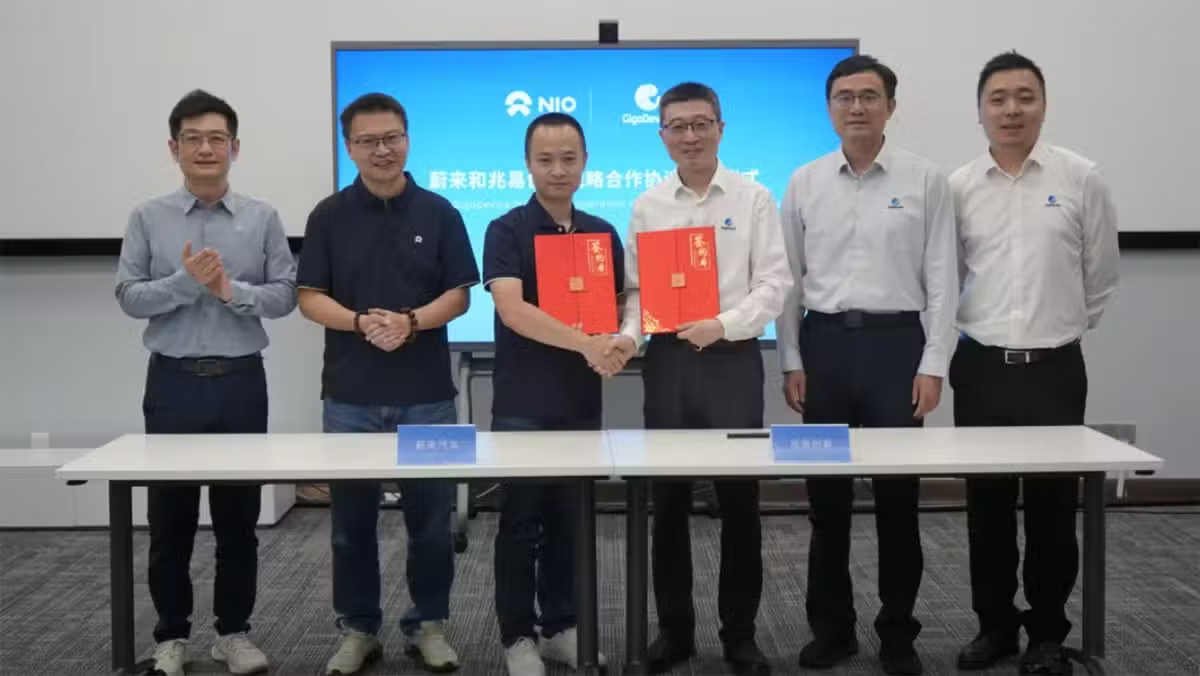
Nio Inc (NYSE: NIO) has signed a strategic partnership agreement with Chinese semiconductor supplier GigaDevice (HKEX: 3986) to jointly advance the research and development of automotive chips.
GigaDevice announced the partnership on Friday, which will focus on collaborative innovation in automotive chips, aiming to support the continuous iteration and technological upgrade of Nio’s smart EVs.
The two companies will leverage their respective professional advantages in chip design and vehicle manufacturing to jointly promote the collaborative R&D of automotive-grade chips and next-generation electrical/electronic architectures.
Relying on its technological advantages and large-scale mass production capabilities in peripheral chips such as memory and microcontrollers (MCUs), GigaDevice will provide Nio with high-performance and highly reliable automotive-grade chip products and system solutions to meet the stringent demands of new-generation smart models, according to a statement.
Nio, in turn, will draw on its experience in vehicle platform development, system integration, and market insights to provide key guidance for the preliminary architecture design, requirement definition, and performance optimization of the chips, as well as vehicle-level validation work.
Beijing-based GigaDevice made its debut on the Hong Kong stock exchange in January this year, amid memory-chip price gains driven by supply shortages as global producers rush to meet surging needs for AI (artificial intelligence).
GigaDevice mainly provides niche memory chips. It was the world’s second-largest supplier of NOR Flash memory for cars, industrial automation, and networking last year, according to a listing document filed with the Hong Kong stock exchange.
The company also sells microcontroller units, which can be found in applications ranging from consumer electronics to energy storage tools.
The strategic partnership with Nio will mainly revolve around core application scenarios such as smart cockpits and smart driving, aiming to bridge the entire chain from chip specification definition to joint R&D, GigaDevice said.
The ultimate goal is to accelerate the translation of innovative technologies into practical applications and work together to create mass-production solutions that set industry benchmarks.
The latest move comes as the Chinese EV industry faces mounting margin pressures due to fierce competition and rising costs, including those of chips.
In addition, the extremely fast pace of product iteration has led to a severe supply-demand imbalance, a phenomenon called by some as the “new car death valley effect,” which has caused massive capital waste.
Nio founder, chairman, and CEO William Li previously issued a stark warning about this and urged the entire industry to accelerate the standardization process for core components.
At the China EV100 forum held in April this year, he proposed standardizing battery cells and significantly reducing the variety of semiconductors.
Li expects these standardization initiatives to create over 100 billion yuan ($14.8 billion) in cost-reduction space for the entire Chinese automotive industry.
The complex variety of chips significantly drives up manufacturing costs, Li said. Citing Nio’s newly launched ES9 SUV (sport utility vehicle) as an example, he noted that the flagship model is equipped with over 1,000 types of semiconductors, using a total of more than 4,000 chips of various kinds, highlighting the urgent need to simplify the supply chain and reduce procurement complexity.
Nio is currently working to drastically slash the variety of chips used internally to around 400, and recommends that the industry jointly promote chip standardization, Li said at the time.
($1 = 6.7675 yuan)