
More than 300,000 Nio and Onvo vehicles are already running on Shenji silicon. That number changes the way you should read Nio’s latest chip news.
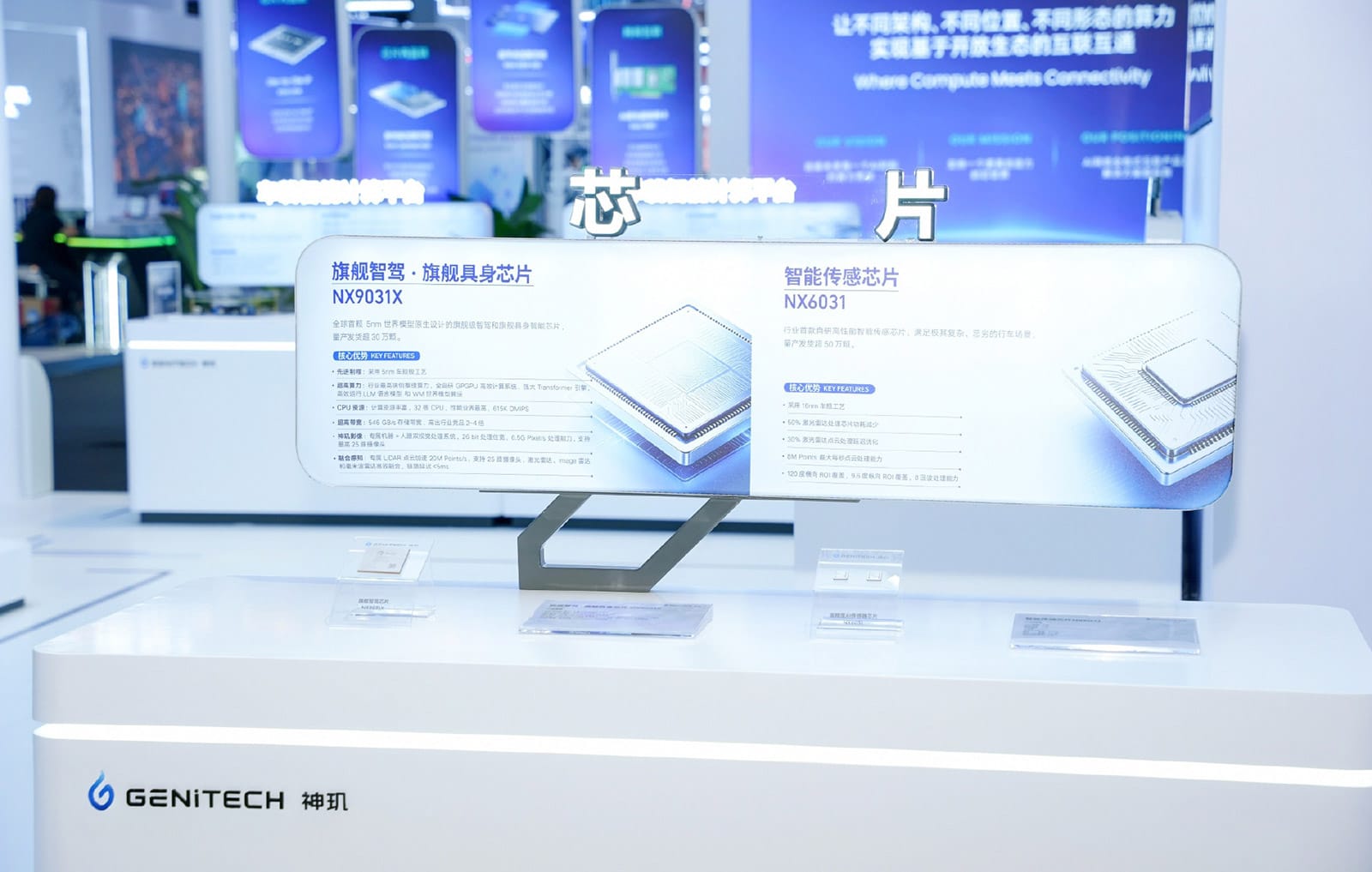
At WAIC 2026 in Shanghai, Nio’s chip subsidiary GeniTech Co Ltd, known in Chinese as Shenji, stepped out under its own name for the first time. The company displayed several chips, including the NX9031X, NX9031U and NX9031C. An image released with Nio’s statement also showed an NX6031 intelligent sensing chip on the stand.
This wasn’t just a glass-case display for investors. Shenji also launched two AI products at the event: the Ruidong embodied intelligence development platform and a distributed intelligent agent platform. In plain English, Nio wants the same chip work it started for smart EVs to move into robots, logistics vehicles, factory equipment and AI terminals that need serious local computing power.
Nio Shenji chips now go beyond smart driving
Shenji says its chip lineup covers three AI uses: intelligent assisted driving, embodied intelligence and agent inference. The NX9031X sits at the top of the family and is already used for assisted driving across all Nio and Onvo models. Shipments have passed 300,000 units, according to Nio.
That last part matters more than the chip name. Plenty of Chinese tech firms can talk about big TOPS numbers. Far fewer can say their automotive-grade chip has been through mass production, daily heat cycles, warranty exposure and real customers getting annoyed when something glitches in traffic.
Nio has been moving in this direction for a while. Its earlier work with GigaDevice on automotive chips already showed that the company didn’t want to leave every piece of vehicle computing to outside suppliers. Shenji is the more expensive, more ambitious version of that bet.
NX9031U: 800 TOPS for robots and industrial AI
The Ruidong embodied intelligence platform runs on the mid-tier NX9031U. Nio says the chip uses a 5-nm automotive-grade process and can handle the models needed for a robot brain, including perception and autonomous planning.
Earlier this week, Shenji said the NX9031U offers equivalent computing power of up to 800 TOPS, uses air cooling, and targets embodied intelligence, intelligent computing and advanced manufacturing. TOPS is not horsepower. It’s a rough measure of how many trillion operations a chip can run per second, and it only tells part of the story. Software, memory bandwidth and power draw decide whether that number turns into useful behavior.
Still, 800 TOPS is not a small claim. For context inside Nio’s own world, older NT 2.0 models came with four Nvidia Orin X chips rated at a combined 1,016 TOPS. Nio previously said one NX9031 delivers computing power equal to four Nvidia Orin chips.
| Metric | Value | Notes |
|---|---|---|
| NX9031X shipments | Over 300,000 units | Used across Nio and Onvo models |
| NX9031U computing power | Up to 800 TOPS equivalent | Air-cooled chip for robots, intelligent computing and manufacturing |
| Process node | 5-nm automotive-grade | Applies to NX9031 and NX9031U disclosures |
| NX9031 transistor count | More than 50 billion | Tape-out announced in July 2024 |
| Shenji financing | Nearly 3 billion yuan ($440 million) | Since establishment in June 2025 |
| February investment | 2.26 billion yuan | Post-investment valuation about 8.27 billion yuan |
| Nio stake after transaction | 62.7 percent | Nio keeps control and consolidates financial statements |
Why Nio wants Shenji selling outside its own EVs
Nio says the NX9031 series is one of the few China-made large-compute chip families for embodied intelligence and agent inference that has already been tested through mass production at scale. That is a very Nio claim: expensive, technical, and aimed at proving the company is more than a car assembler.
Ma Lin, Nio’s vice president of branding and communications, said on Weibo that Shenji is currently the only company in China shipping chips across autonomous driving, embodied intelligence and agent reasoning. He said the business started inside Nio’s in-car work, moved into mass production of core smart-driving chips, and is now expanding into outside supply.
The company describes Shenji as an all-domain, all-scenario chip company covering autonomous driving, embodied intelligence and agent inference. Strip away the corporate phrasing and the plan is simple: Nio spent billions creating a chip for its cars, and now it wants more customers to help carry the cost.
This is where the China angle gets interesting. BYD has batteries, power electronics and scale. Xiaomi has phones, software and consumer tech gravity. Nio has battery swap, premium branding and now a serious semiconductor story. BYD’s own chip work is worth watching too, especially after its new smart driving chip push, but Nio is taking a more vertical route around high-end compute.
The cost problem behind Nio’s semiconductor plan
The uncomfortable bit is money. Nio’s chip program has been one of the heaviest items in its R&D spending. William Li, Nio’s founder, chairman and CEO, once said the NX9031 development cost ran into billions of yuan, close to the cost of building 1,500 battery swap stations.
That comparison is brutal because battery swap is one of the few Nio features buyers can feel immediately. A chip, even a good one, is invisible until the assisted-driving software does something better than the rival car next to it.
To ease funding pressure while keeping the long-term tech program alive, Nio confirmed in February that several Chinese investors would put 2.26 billion yuan into Shenji. The deal valued the business at about 8.27 billion yuan after investment. After the transaction, a Nio subsidiary still holds a 62.7 percent controlling stake, and Nio Inc still consolidates Shenji in its financial statements.
Shenji has raised nearly 3 billion yuan, or $440 million, since it was established in June 2025. The dollar conversion used by Nio was $1 to 6.7733 yuan.
What this means for Nio buyers
If you’re shopping for a Nio or Onvo, don’t buy the car just because Shenji has a booth at an AI conference. Buy it because the vehicle fits your use case: charging access, swap station coverage, cabin quality, service support and how much you trust Nio’s software updates in your city.
The chip does matter, though. In China, where assisted-driving features are becoming a purchase trigger in the 200,000 yuan to 400,000 yuan bands, in-house compute can give Nio tighter control over cost and software timing. That matters when rivals are cutting prices and adding smarter driver-assist features every quarter. Nio’s rising premium positioning, covered in our piece on Nio’s higher average transaction prices, depends on giving buyers more than nice seats and a big screen.
Outside China, the buyer math is different. Service availability, resale uncertainty and charging or swap access still carry more weight than which chip handles perception. A local dealer who can fix the car next week beats a fancy TOPS figure every time.
Should you buy now or wait?
For Chinese buyers already considering a Nio or Onvo, Shenji is a reason to feel better about long software support, not a reason to stretch the budget. The NX9031X is already in mass-market use across Nio and Onvo, so this isn’t vaporware.
For buyers abroad, wait until Nio proves the full ownership package in your market: service centers, parts supply, residual values and charging convenience. The chip story is real. The ownership story still has to be proven country by country.
The bigger industry signal is harder to ignore. Chinese EV makers are no longer content to assemble batteries, motors and Nvidia boxes into good-looking cars. Li Auto is also pushing deeper into software and AI, as seen with its embodied intelligence event plans. Nio’s Shenji move says the fight is shifting into chips, models and control loops. Expensive territory. But if Nio can sell Shenji beyond its own garages, the bet starts to look less like vanity engineering and more like a second business hiding inside an EV company.